About 57 minutes
The Mentor: Russian Music, Vol. 4, Num. 18, Serial No. 118, November 1, 1916 — Reading Notes
Composers
13,086 recorded words. 12 minutes difference from this book's estimate.
View Gutenberg source #51993
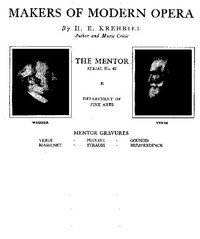
The catalog record for The Mentor: Makers of Modern Opera, Vol. 1, Num. 47, Serial No. 47 — Story, Setting & Ideas provides practical reading context through 10,248 words, 45 min estimated reading time, and 7 detected text sections.
The text analysis averages about 20.3 words per sentence, while the detected sections provide another way to judge how the source is divided.
Project Gutenberg metadata also associates the work with “Opera,” connecting these edition facts with the source record’s subject description.
Explore this collection
These alternatives are selected using recorded categories and estimated reading time.
About 57 minutes
Composers
13,086 recorded words. 12 minutes difference from this book's estimate.
View Gutenberg source #51993About 24 minutes
Composers
5,399 recorded words. 21 minutes difference from this book's estimate.
View Gutenberg source #35097About 21 minutes
Composers
4,745 recorded words. 24 minutes difference from this book's estimate.
View Gutenberg source #35596Search stored excerpts and compare books → Choose by your preferences →
Choices use stored catalog measurements. Estimates vary with reading speed. A shared category is a catalog label, not a claim that two books have the same argument or literary quality.
Search reads excerpt text stored with this catalog and links to its associated Gutenberg record. The connection is stored in the site database; this tool does not recheck that every excerpt is word-for-word identical to that external record. Excerpt search does not cover every chapter and does not verify historical publication dates.
Catalog snapshot checked: 2026-09-25. Coverage: 90 public books, 90 available source excerpts.
Read the complete public-domain text at its original source.
Read on Project GutenbergHenry Edward Krehbiel's Makers of Modern Opera (1914) presents itself as a survey of operatic composers, yet the excerpts reveal a work more concerned with biographical sketches and national lineages than with musical technique. The catalog subjects—Opera and Composers—are accurate but incomplete: the text's emphasis falls on the lives and careers of Verdi, Wagner, Massenet, Puccini, and others, with only passing references to their actual compositions. Krehbiel, a noted music critic, frames opera's evolution as a story of national schools emerging from Italian origins, a narrative that shapes his selection and treatment of figures.
The excerpts devote far more space to composers' life events than to their music. Verdi's entry, for instance, details his birth year (1813), his longevity (88 years), and the number of his operas (twenty-nine), but offers only general statements about his style—such as that his conception of melody "changed as his artistic nature grew and ripened." Massenet's section recounts his poverty, his service in the Franco-Prussian War, and his professorship at the Paris Conservatory, yet describes his music merely as "weak and sugary" and "superficially clever." Puccini is introduced as "named by the great Verdi as his probable successor," with his lineage traced back to his great-great-grandfather. This biographical focus suggests that the intended audience was general readers seeking introductions to composers' lives rather than detailed musical analysis.
Krehbiel structures his narrative around the emergence of distinct national operatic schools. He traces opera's origin to a Florentine group that sought to revive Greek drama, then describes how translations of Italian librettos led to "recognition of the incongruity between Italian music and the French, German, and English languages," prompting each nation to develop its own idiom. The text explicitly identifies "the three great schools of operatic composers" whose latter-day representatives are considered. This framework elevates Verdi and Wagner as twin points of departure, born in the same year (1813), and positions later figures like Massenet and Puccini as heirs to these national traditions. The catalog subject "Composers" thus understates the text's active construction of a historical narrative.
Despite the title's promise of "Makers of Modern Opera," the excerpts cover only a handful of composers in depth. The Mentor gravures list Verdi, Massenet, Puccini, Strauss, Gounod, and Humperdinck, but the text itself focuses primarily on Verdi, with substantial sections on Donizetti, Rossini, Massenet, and Puccini. Wagner is mentioned as a counterpart to Verdi but receives no dedicated excerpt in the provided material. The treatment of Massenet includes critical remarks—his style called "weak and sugary"—while Verdi is praised for never disavowing "the native genius of his people." This uneven coverage suggests that the work is not a comprehensive survey but a selective introduction, shaped by Krehbiel's critical judgments and the constraints of the Mentor series' format.
Readers should approach this text as a period piece that reflects early 20th-century music criticism and popular education. Krehbiel's biographical emphasis and national-school framework offer insight into how opera history was presented to a general audience a century ago. The excerpts provide a useful starting point for understanding the reputations of these composers at the time, but they do not substitute for deeper musical analysis or more recent scholarship.
I keep circling back to how Krehbiel framed composers through their homelands, their biographies, not their notes. It reminds me of sitting with The Lion of Poland: The Story of Paderewski — A Closer Reading, where the man’s exile felt louder than any of his keyboard work. That same ache—nationhood wearing a person’s face—surfaced there, quiet and persistent.
Build a private reading journal entry for this title.