About 232 minutes
Charles Gounod Autobiographical Reminiscences with Family Letters and Notes on Music — Themes and Context
Composers
53,286 recorded words. 10 minutes difference from this book's estimate.
View Gutenberg source #35812
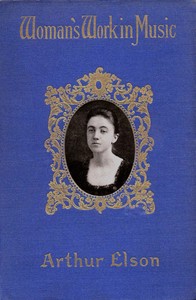
Before opening Woman's Work in Music — Themes and Context, the edition data offers a quick orientation: 55,634 words, 4 hr 2 min estimated reading time, and 8 detected text sections.
The text analysis averages about 16.7 words per sentence, while the detected sections provide another way to judge how the source is divided.
Project Gutenberg metadata also associates the work with “Women musicians,” connecting these edition facts with the source record’s subject description.
Explore this collection
These alternatives are selected using recorded categories and estimated reading time.
About 232 minutes
Composers
53,286 recorded words. 10 minutes difference from this book's estimate.
View Gutenberg source #35812About 225 minutes
Composers
51,640 recorded words. 17 minutes difference from this book's estimate.
View Gutenberg source #56593About 222 minutes
Composers
50,948 recorded words. 20 minutes difference from this book's estimate.
View Gutenberg source #75908Search stored excerpts and compare books → Choose by your preferences →
Choices use stored catalog measurements. Estimates vary with reading speed. A shared category is a catalog label, not a claim that two books have the same argument or literary quality.
Search reads excerpt text stored with this catalog and links to its associated Gutenberg record. The connection is stored in the site database; this tool does not recheck that every excerpt is word-for-word identical to that external record. Excerpt search does not cover every chapter and does not verify historical publication dates.
Catalog snapshot checked: 2026-09-25. Coverage: 90 public books, 90 available source excerpts.
Read the complete public-domain text at its original source.
Read on Project GutenbergArthur Elson opens his 1903 survey with a paradox: the Church of Rome, which excluded women from performing its services, nonetheless made a woman—Saint Cecilia—the patron saint of music. He notes that the scant historical evidence for Cecilia (a passing phrase about her uniting instrumental and vocal praise) contrasts sharply with the vast cultural legacy she inspired, including paintings, poetry, and statues. This tension between limited documentation and outsized influence sets the tone for a book that seeks to weigh women's actual musical contributions against the romanticized or neglected record.
Elson's method is biographical and evaluative. He moves from ancient goddesses to medieval figures, then to the wives of famous composers, and finally to a country-by-country account of women composers and performers. His prose is brisk, often opinionated, and grounded in specific works—he mentions Liza Lehmann's song cycle In a Persian Garden and its initial rejection by London publishers, for instance—rather than in abstract praise.
Elson's voice is that of an informed critic, not a neutral chronicler. He freely judges: Frances Allitsen's works are marked by “gentleness of thought,” while Liza Lehmann's Persian Garden is “full of rich passages of exquisite beauty, moving pathos, and strong expression.” Such evaluations are frequent, giving the text a persuasive, almost polemical edge. Yet the tone is not uniformly laudatory. When discussing the many women who produced only a few piano pieces, Elson remarks that “almost every eminent performer is at some time tempted to express his own musical thoughts in writing,” implying that composition was often a secondary, less serious pursuit.
The voice also shifts with the subject. In the chapter on ancient and mythical women, the prose is more speculative and literary—he dwells on the “apocryphal legend” of Saint Cecilia and the “passing phrase” that made her famous. Later, when profiling living or recent composers, the writing becomes more reportorial, filled with dates, teachers, and publication details. This change in pace mirrors the book's movement from myth to documented history.
Elson organizes each chapter as a series of compact biographies, typically two to four paragraphs per figure. This creates a staccato rhythm: a new name, a birthplace, a teacher, a few works, a judgment. For example, Arabella Goddard is introduced with her precocious debut at age four, her studies with Kalkbrenner, her performance before Queen Victoria, and her published waltzes—all in three sentences. The pace accelerates when Elson lists composers in groups, as when he writes of “the long list of song composers” and singles out only a few for extended treatment.
This structure can feel breathless, but it also mirrors the breadth of Elson's research. He covers dozens of women across eight chapters, and the rapid succession of names underscores the sheer number of women active in music. The pace slows only for figures he deems especially significant, such as Clara Schumann (who gets her own chapter) or Liza Lehmann, whose career is narrated in greater detail, including the anecdote about her nervousness as a singer and the private premiere of her famous cycle.
Several patterns recur across the biographies. Many women composers began as child prodigies: Arabella Goddard played at four, Amina Beatrice Goodwin at six. Others were singers who turned to composition after losing their voices or retiring from the stage—Liza Lehmann and Frances Allitsen both followed this path. Elson also notes the role of family opposition: Allitsen's family “were all hostile to a musical career,” and she grew up in a village “where, if a girl went out to walk, she was accused of wanting to see the young men come in on the train.”
These repeated details hint at broader social constraints. The child-prodigy narrative suggests that early encouragement was possible, but the later shift from performance to composition—often after marriage or voice loss—implies that sustained creative careers were harder for women to maintain. Elson does not explicitly argue this, but the accumulation of such examples gives the book an implicit sociological dimension beneath its biographical surface.
Readers should approach Woman's Work in Music as a document of its time: Elson's judgments reflect early-twentieth-century tastes, and his coverage is uneven—English and German composers receive more attention than those from other regions. The book is best read not as a definitive history but as a snapshot of how one critic tried to assemble and evaluate women's musical achievements at a moment when the canon was still being formed. Pay attention to the gaps and the recurring patterns; they reveal as much about the era's assumptions as about the composers themselves.
There’s something unexpectedly tender about reading Arthur Elson’s old survey of women in music—it feels like listening to someone remember names the world almost forgot. It made me think of another quiet companion, Frederick Chopin, as a Man and Musician — Complete — Context and Discussion, where the man behind the notes becomes just as haunting as the music itself. Both books leave a strange, gentle ache.
Use these questions to collect your thoughts before moving on.