About 45 minutes
The Mentor: Makers of Modern Opera, Vol. 1, Num. 47, Serial No. 47 — Story, Setting & Ideas
Composers
10,248 recorded words. 12 minutes difference from this book's estimate.
View Gutenberg source #49932
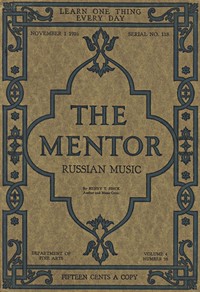
For The Mentor: Russian Music, Vol. 4, Num. 18, Serial No. 118, November 1, 1916 — Reading Notes, the stored edition analysis reports 13,086 words, 57 min estimated reading time, and 8 detected text sections.
The text analysis averages about 17.2 words per sentence, while the detected sections provide another way to judge how the source is divided.
Project Gutenberg metadata also associates the work with “Music -- Russia -- History and criticism,” connecting these edition facts with the source record’s subject description.
Explore this collection
These alternatives are selected using recorded categories and estimated reading time.
About 45 minutes
Composers
10,248 recorded words. 12 minutes difference from this book's estimate.
View Gutenberg source #49932About 24 minutes
Composers
5,399 recorded words. 33 minutes difference from this book's estimate.
View Gutenberg source #35097About 21 minutes
Composers
4,745 recorded words. 36 minutes difference from this book's estimate.
View Gutenberg source #35596Search stored excerpts and compare books → Choose by your preferences →
Choices use stored catalog measurements. Estimates vary with reading speed. A shared category is a catalog label, not a claim that two books have the same argument or literary quality.
Search reads excerpt text stored with this catalog and links to its associated Gutenberg record. The connection is stored in the site database; this tool does not recheck that every excerpt is word-for-word identical to that external record. Excerpt search does not cover every chapter and does not verify historical publication dates.
Catalog snapshot checked: 2026-09-25. Coverage: 90 public books, 90 available source excerpts.
Read the complete public-domain text at its original source.
Read on Project GutenbergHenry T. Finck opens his 1916 survey of Russian music with a series of blunt questions and answers, establishing a brisk, informative tone. He notes that Russia's area exceeds 8,660,000 square miles and that its population was over 150,000,000 before the war, then immediately pivots to ask how many famous Russian composers exist—"Less than a dozen." This direct, almost pedagogical approach frames the entire essay: Finck is not writing a scholarly monograph but a concise primer for a general audience. He attributes the late emergence of Russian music to "physical and human conditions," specifically an absolute monarchy and widespread ignorance, and declares that only within the last century has Russia "wakened to a national consciousness." The voice of music, he asserts, is first heard as a national expression in this new era.
Finck introduces Mikhail Glinka by emphasizing two personal traits: "an extremely nervous disposition and a lively aptitude for music." He traces the first to Glinka's grandmother, an invalid who "mollycoddled" the boy, and the second to his father. This psychological sketch is unusual for a short survey—Finck uses it to explain Glinka's brooding tendency, which he never fully shed. The turning point comes with Glinka's opera A Life for the Czar (1836), which Finck calls the inauguration of the Russian school. He does not describe the plot but positions the work as a national milestone. The language is brisk: Glinka "tired of the laurels of a performer" and aimed to become "the Russian Beethoven," though Finck judges he reached only Mendelssohn's level. This blunt assessment is typical of Finck's critical voice throughout the essay.
Anton Rubinstein is presented as a composer of abundant melody, with 238 piano pieces alone, yet Finck argues his operas failed because he "stubbornly refused to swim with the Wagnerian current." The critic admires Rubinstein's "glowing Oriental and Hebrew 'coloring'" and his use of national Russian melodies, but notes he did not employ them as extensively as Glinka and the nationalists. Finck calls for a Rubinstein revival, citing three operas—The Demon, Nero, and The Maccabees—as candidates. He attributes Rubinstein's bitterness to failed schemes, such as a theater for his "sacred operas" on Biblical subjects, which he describes as "really oratorios with scenery, action and costumes." The portrait is sympathetic but critical: Rubinstein had genius but limited self-awareness.
Finck devotes his most vivid language to Tchaikovsky, whom he calls "the most melancholy" of Russian composers. He singles out the Pathetic Symphony as the most popular orchestral work of any country, second to none, and describes its final adagio lamentoso as "the concentrated quintessence of despair, 'the luxury of woe.'" He notes the rumor that Tchaikovsky wrote it as his own dirge before suicide, but corrects this: he died of cholera. Finck attributes the symphony's appeal to its "abundance of soulful melody," and ranks Tchaikovsky with Haydn, Mozart, Schubert, and other great melodists. The passage is notable for its emotional intensity and for Finck's willingness to engage with the work's affective power rather than merely cataloging facts.
Finck contrasts the nationalists—Glinka's followers—with Rubinstein, who used Russian melodies less extensively. He frames the national movement as a deliberate turn away from Italian and German models, rooted in folk songs and legends. The essay's structure implies a hierarchy: Glinka founded the school, the nationalists developed it, and Tchaikovsky transcended it. Finck's recurring emphasis on melody—"Opera goers love, above all things, melody"—reveals his critical priorities. He praises Rubinstein's melodic gifts but faults his operatic failures; he celebrates Tchaikovsky's melodic flow. The nationalists are mentioned but not examined in detail, suggesting the essay's scope is limited to a few key figures. Finck's voice remains authoritative, opinionated, and focused on what he considers musically essential.
Finck's essay is best read as a critic's snapshot of Russian music in 1916, not a comprehensive history. He writes with a clear hierarchy of values—melody above all, national character important but secondary—and does not hesitate to judge. Readers should note his tendency to measure Russian composers against Western standards (Beethoven, Mendelssohn, Wagner) and his frank assessments of failure. The excerpts leave many figures undiscussed; the nationalists beyond Glinka receive only a nod. Approach this as a period piece that reveals early 20th-century American critical taste as much as its subject.
I have often set Finck’s 1916 Russian survey beside the old letters of Beethoven, not for their facts, but for their shared temper. Both show composers wrestling with melody as a national heartbeat. There is a quiet kinship there, in how a critic’s ear catches what a friend’s letter confesses. The Life of Beethoven Including his correspondence with his friends, numerous characteristic traits, and remarks on his musical works — A Closer Reading lingers in my memory for that very humanness.
Save your reaction, strongest insight, and memorable passage.