About 21 minutes
Robt. Schumann : The Story of the Boy Who Made Pictures in Music — Reading Notes
Composers
4,745 recorded words. 3 minutes difference from this book's estimate.
View Gutenberg source #35596
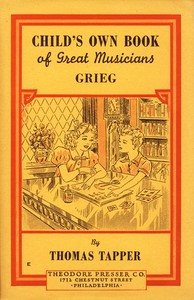
The catalog record for Edvard Grieg : The Story of the Boy Who Made Music in the Land of the Midnight Sun — Inside the Classic provides practical reading context through 5,399 words, 24 min estimated reading time, and 1 detected text section.
The text analysis averages about 19.9 words per sentence, while the detected sections provide another way to judge how the source is divided.
Project Gutenberg metadata also associates the work with “Grieg, Edvard, 1843-1907 -- Juvenile literature,” connecting these edition facts with the source record’s subject description.
Explore this collection
These alternatives are selected using recorded categories and estimated reading time.
About 21 minutes
Composers
4,745 recorded words. 3 minutes difference from this book's estimate.
View Gutenberg source #35596About 15 minutes
Composers
3,409 recorded words. 9 minutes difference from this book's estimate.
View Gutenberg source #60012About 45 minutes
Composers
10,248 recorded words. 21 minutes difference from this book's estimate.
View Gutenberg source #49932Search stored excerpts and compare books → Choose by your preferences →
Choices use stored catalog measurements. Estimates vary with reading speed. A shared category is a catalog label, not a claim that two books have the same argument or literary quality.
Search reads excerpt text stored with this catalog and links to its associated Gutenberg record. The connection is stored in the site database; this tool does not recheck that every excerpt is word-for-word identical to that external record. Excerpt search does not cover every chapter and does not verify historical publication dates.
Catalog snapshot checked: 2026-09-25. Coverage: 90 public books, 90 available source excerpts.
Read the complete public-domain text at its original source.
Read on Project GutenbergThomas Tapper's Edvard Grieg: The Story of the Boy Who Made Music in the Land of the Midnight Sun (1921) is not a conventional biography. It is part of the Child's Own Book of Great Musicians series, designed as a hands-on activity: children cut out illustrations, paste them into designated spaces, and later write their own story of the composer on blank pages. The book itself is to be sewn together by the child using a provided cord and needle. This physical engagement frames the reading experience as a craft project, where learning about Grieg becomes intertwined with making the book one's own.
The book's instructions reveal its dual purpose: to teach “the main facts” about a composer while giving the child a tangible, personalized object. The child is directed to cut illustrations from a sheet and paste each “in its proper place throughout the book,” matching numbers on the pictures to spaces in the text. After this, blank pages await “the child's own story of the great musician, based upon the facts and questions found on the previous pages.” Finally, the child sews the book together. This process transforms reading into making—a stark contrast to passive consumption. The biography is thus a scaffold for active learning, where the child assembles both the narrative and the physical book.
The opening pages immediately establish a tension between place and personal creativity. Grieg is introduced as “a boy who was born in the north of the world” who “loved his mother country and the music which the people sang.” Yet the text insists that “he had music, all his own, that sang and sang in his heart.” This inner music is described in contrasting pairs: “happy music and sad; solemn and joyous.” The phrasing suggests a duality—the boy is rooted in Norwegian folk tradition, but his individual voice transcends it. The subtitle, “The Land of the Midnight Sun,” reinforces the exotic northern setting, while the repeated emphasis on the boy's own music hints at a creative independence that will later define Grieg's compositions.
Tapper's series includes twenty-one composers, from Bach to Wagner, each treated in the same format. The back matter lists them all, grouping figures like Beethoven, Chopin, and Grieg together. This uniformity suggests a systematic approach to music education: each child builds a library of self-made books, each covering one composer's life in digestible facts. The instructions emphasize that the series “will be found not only to furnish a pleasing and interesting task for the children, but will teach them the main facts.” The word “facts” recurs, underscoring an educational philosophy that values memorizable data over interpretation. Yet the blank pages for the child's own story leave room for personal response, balancing rote learning with creative synthesis.
The book's physical design makes the reader an active participant. By cutting, pasting, and sewing, the child literally constructs the biography. This process mirrors the way Grieg himself assembled Norwegian folk melodies into his compositions—a parallel the text does not explicitly draw but which emerges from the activity. The child is not a passive recipient of information but a maker of meaning. The final blank pages invite the child to write “his own story,” using the facts and questions provided. This turns the biography into a prompt for original work, much as Grieg's childhood love of folk music became the raw material for his art. The book thus enacts the very creativity it describes.
Readers approaching this edition should note that the excerpts are incomplete, missing the main biographical narrative and the illustrations. The text available focuses on the book's paratexts—instructions, series list, and copyright—rather than on Grieg's life. Any analysis of the biography's content is necessarily limited. However, the surviving material reveals a remarkable pedagogical design: a book that teaches by doing, inviting the child to become both reader and maker. This editorial note has focused on that design, leaving the full story of Grieg's life to be discovered when the complete text is consulted.
Reading about Tapper's cut-and-paste Grieg, I remembered assembling those little biographies as a child, the scissors dull, the paste sticky. That pieced-together feeling returns whenever I open The World's Great Men of Music: Story-Lives of Master Musicians — Context and Discussion, each composer recounted like a familiar tune hummed in a quiet room, halting but warm.
Create a short personal record of your experience with this book.