About 142 minutes
Edward MacDowell: A Great American Tone Poet, His Life and Music — Themes and Context
Composers
32,651 recorded words. 6 minutes difference from this book's estimate.
View Gutenberg source #14185
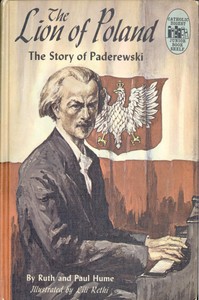
The catalog record for The Lion of Poland: The Story of Paderewski — A Closer Reading provides practical reading context through 33,869 words, 2 hr 28 min estimated reading time, and 6 detected text sections.
The text analysis averages about 16.9 words per sentence, while the detected sections provide another way to judge how the source is divided.
Project Gutenberg metadata also associates the work with “Paderewski, Ignace Jan, 1860-1941 -- Juvenile literature,” connecting these edition facts with the source record’s subject description.
Explore this collection
These alternatives are selected using recorded categories and estimated reading time.
About 142 minutes
Composers
32,651 recorded words. 6 minutes difference from this book's estimate.
View Gutenberg source #14185About 194 minutes
Composers
44,408 recorded words. 46 minutes difference from this book's estimate.
View Gutenberg source #58562About 222 minutes
Composers
50,948 recorded words. 74 minutes difference from this book's estimate.
View Gutenberg source #75908Search stored excerpts and compare books → Choose by your preferences →
Choices use stored catalog measurements. Estimates vary with reading speed. A shared category is a catalog label, not a claim that two books have the same argument or literary quality.
Search reads excerpt text stored with this catalog and links to its associated Gutenberg record. The connection is stored in the site database; this tool does not recheck that every excerpt is word-for-word identical to that external record. Excerpt search does not cover every chapter and does not verify historical publication dates.
Catalog snapshot checked: 2026-09-25. Coverage: 90 public books, 90 available source excerpts.
Read the complete public-domain text at its original source.
Read on Project GutenbergRuth and Paul Hume open their biography of Ignacy Jan Paderewski not with a concert hall or a political stage, but with a pounding at the door. That early scene—a childhood memory of a mysterious visitor—sets a pattern of suspense that recurs throughout the book. The authors alternate between close-up vignettes of domestic life at Riond-Bosson and sweeping accounts of European power struggles, a structural choice that mirrors Paderewski’s own double life as artist and statesman. The narrative voice remains steady, even when the subject matter veers from a kitchen-sink parody of a Schoenberg symphony to the outbreak of World War I. This note traces how the Humes manage those shifts in pace and perspective, and what the excerpts reveal about their method.
The excerpt from the Riond-Bosson episode shows the Humes at their most playful. The description of a makeshift orchestra raiding the kitchen for pots, pans, eggbeaters, and typewriters builds a comic crescendo that ends with the conductor diving headfirst into a rain barrel. The language is brisk and theatrical: “the exhausted conductor himself plunged head first into the barrel.” Then, without transition, the telephone rings. The authors compress the shift from farce to dread into a single paragraph: “Why, then, was there so ominous a quality in the sound of it now?” The pacing abruptly slows. Paderewski disappears up a short flight of steps; when he reappears, his words are quiet: “My friends, the war is here.” The contrast is deliberate. The Humes use the sudden stillness after the crash to make the war’s arrival feel physically jarring, as if the reader has been pulled from a party into a nightmare. This technique—juxtaposing a lighthearted set piece with a grave announcement—recurs in the book, and it suggests that the authors see Paderewski’s life as a series of such ruptures.
The Humes’ narrative voice is consistently omniscient but not detached. They allow themselves moments of pointed commentary, especially when describing political hypocrisy. After quoting the Czar’s proclamation offering “freedom and love to his beloved Poles,” they add: “Paderewski and his fellow-Poles could hardly keep from laughing a very bitter laugh indeed at this sudden change of heart.” The phrase “very bitter laugh” is the authors’ own judgment, not a reported quote. It signals a wry, knowing tone that runs through the political sections. Elsewhere, they use rhetorical questions to underscore irony: “It couldn’t be, could it, that the Russians were hoping to line up Polish support…?” This technique invites the reader to share the authors’ skepticism. The voice is never neutral; it carries a clear sympathy for Paderewski’s cause and a sharp eye for the gap between official rhetoric and reality. The excerpts do not show whether this tone persists throughout the book, but it is consistent in the passages provided.
The Humes vary sentence length to signal shifts in emotional intensity. In the war scene, short declarative sentences dominate: “The war had come, as inevitably it would.” Then a longer, more reflective sentence follows: “How ironic, thought Paderewski, that in the cataclysm of war would be found the means of freeing Poland from a century and a half of bondage.” The authors move from external event to internal thought without a break, blending action and reflection. This technique gives the reader access to Paderewski’s perspective without explicit psychological analysis. Later, when Paderewski points to a map of Poland and says, “But while Poland’s jailers attack each other, their captive will escape!” the pacing quickens again. The gesture—a finger on a map—is cinematic. The Humes use such physical details to anchor abstract political shifts. The map, the telephone, the rain barrel: each object becomes a pivot point where the narrative changes speed. Based on these excerpts, the book seems to rely on concrete, often domestic objects to ground its larger historical arguments.
Readers approaching The Lion of Poland should attend to the way the Humes orchestrate their scenes. The book does not simply chronicle events; it builds each chapter around a dramatic turn, often signaled by a sound or an object. The authors trust their readers to follow the leaps from laughter to grief, from a Swiss estate to the battlefields of Europe. This is not a quiet biography. It is a performance in its own right, one that asks us to hear the telephone ringing through the applause.
There’s a moment in The Lion of Poland where Paderewski’s greatness feels almost accidental—just a man at a piano, the world’s noise fading. It reminded me how rarely we sit with an artist’s inner quiet. That old book, Musicians of to-day — Key Ideas to Explore, has that same hush between its lines, like listening to someone breathe between notes. I keep returning to both. Just that.
Your answers remain private and are stored only in this browser.