About 24 minutes
Edvard Grieg : The Story of the Boy Who Made Music in the Land of the Midnight Sun — Inside the Classic
Composers
5,399 recorded words. 3 minutes difference from this book's estimate.
View Gutenberg source #35097
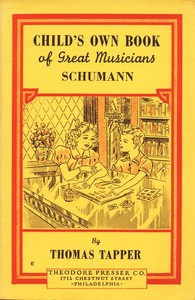
Before opening Robt. Schumann : The Story of the Boy Who Made Pictures in Music — Reading Notes, the edition data offers a quick orientation: 4,745 words, 21 min estimated reading time, and 1 detected text section.
The text analysis averages about 20.5 words per sentence, while the detected sections provide another way to judge how the source is divided.
Project Gutenberg metadata also associates the work with “Composers -- Germany -- Biography -- Juvenile literature,” connecting these edition facts with the source record’s subject description.
Explore this collection
These alternatives are selected using recorded categories and estimated reading time.
About 24 minutes
Composers
5,399 recorded words. 3 minutes difference from this book's estimate.
View Gutenberg source #35097About 15 minutes
Composers
3,409 recorded words. 6 minutes difference from this book's estimate.
View Gutenberg source #60012About 45 minutes
Composers
10,248 recorded words. 24 minutes difference from this book's estimate.
View Gutenberg source #49932Search stored excerpts and compare books → Choose by your preferences →
Choices use stored catalog measurements. Estimates vary with reading speed. A shared category is a catalog label, not a claim that two books have the same argument or literary quality.
Search reads excerpt text stored with this catalog and links to its associated Gutenberg record. The connection is stored in the site database; this tool does not recheck that every excerpt is word-for-word identical to that external record. Excerpt search does not cover every chapter and does not verify historical publication dates.
Catalog snapshot checked: 2026-09-25. Coverage: 90 public books, 90 available source excerpts.
Read the complete public-domain text at its original source.
Read on Project GutenbergThomas Tapper's 1916 biography frames Robert Schumann not as a distant historical figure but as a boy who 'used to amuse his friends by playing their pictures on the piano.' The book's subtitle, The Story of the Boy Who Made Pictures in Music, signals its central image: music as a form of portraiture. Tapper draws a direct line from Schumann's childhood game—imitating a farmer's walk in 'The Happy Farmer'—to the adult composer's collections of character pieces, which the author describes as 'music picture[s]' that let listeners 'see them very plainly indeed.'
The volume belongs to the Child's Own Book of Great Musicians series, designed as a hands-on project. Children cut out illustrations, paste them into designated spaces, and later write their own biography on blank pages, then sew the book together with a provided cord. This physical engagement mirrors the book's emphasis on active listening and imaginative seeing.
Tapper organizes Schumann's life around the idea that his music creates visual scenes. The opening anecdote—Schumann playing 'pictures' of his friends—establishes a pattern: each piece is a snapshot of a person, mood, or activity. The author mentions a 'music picture of a boy riding a rocking horse' from one of Schumann's books, grounding the claim in a specific example. This approach simplifies complex musical concepts into relatable images, making the biography accessible to children without condescension.
The structure moves chronologically but pauses on moments that illustrate this pictorial quality. Tapper does not attempt a full life narrative; instead, he selects episodes that reinforce the subtitle's promise. The result is a selective portrait that prioritizes the composer's imaginative process over biographical completeness.
Several excerpts repeat actions that translate easily into musical imagery. The farmer 'comes home singing from his work,' the boy rides a 'rocking horse'—both are rhythmic, repetitive motions that Schumann could capture in short piano pieces. Tapper emphasizes that Schumann's music 'picture[s] the pleasantest things,' suggesting a focus on domestic, cheerful scenes rather than dramatic or tragic ones.
This selection of motifs aligns with the book's intended audience: children who themselves play, walk, and ride. By connecting Schumann's compositions to everyday movements, Tapper makes the music feel familiar and playable. The recurring image of the 'happy farmer' also ties into a pastoral tradition, but Tapper keeps it concrete—a man walking and singing, not an abstract ideal.
The book shifts abruptly from storytelling to instruction. After introducing Schumann's childhood trick, Tapper addresses the reader directly: 'Some day you will be able to play a lot of pieces by Schumann.' This leap from past to future, from the composer's youth to the child's potential, characterizes the book's structure. It moves between biographical anecdote and practical invitation, often within the same paragraph.
The inclusion of a binding diagram and paste-in illustrations further breaks the narrative flow. These elements are not appendices but integral to the book's design. The child is told to 'cut apart' the illustrations and 'insert' them 'in its proper place.' This physical movement—cutting, pasting, sewing—parallels the mental movement between reading and doing. Tapper expects the child to become an active participant, not a passive reader.
Blank pages at the back invite the child to 'write his own story of the great musician, based upon the facts and questions found on the previous pages.' This transforms the biography into a template. The child is not merely consuming information but reconstructing it. The sewing step—'the book is then to be sewed by the child through the center with the cord'—makes the child the physical creator of the volume.
Tapper's language reinforces this ownership: the book 'thus becomes the child's own book.' The series title, Child's Own Book of Great Musicians, literalizes the concept. The editorial note itself is part of a larger pedagogical project that values making over passive learning. The child's final product—a hand-sewn, hand-illustrated, hand-written biography—embodies the book's central lesson: that understanding music, like making it, is an active, personal craft.
Readers should approach this book as a kit as much as a biography. The narrative is deliberately fragmentary, designed to be completed by the child's own writing and assembly. Pay attention to the spaces left for illustrations and the blank pages at the end; they are not afterthoughts but the book's true conclusion. Tapper's Schumann is a starting point, not a final word—an invitation to make the composer's pictures one's own.
I keep thinking about how Tapper’s Schumann book treats music as something a boy sees—pictures forming before the notes arrive. Reading it, I remembered the quieter pleasure in Story-Lives of Great Musicians — Context and Discussion, where those pictures stay more tentative, more like half-remembered dreams. Both leave me with the same gentle ache: that childhood way of listening, so easily lost.
Answer a few questions and save a private reflection on this device.