
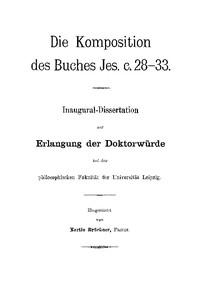
Die Komposition des Buches Jes. c. 28-33. by Martin Brückner
Read "Die Komposition des Buches Jes. c. 28-33. by Martin Brückner" Online
This book is available in the public domain. Start reading the digital edition below.
Book Preview
A short preview of the book’s content is shown below to give you an idea of its style and themes.
Let's be clear from the start: this isn't a book about the spiritual meaning of Isaiah. If you're looking for a devotional guide, you're in the wrong place. Martin Brückner, writing over a century ago, had a different goal. He wanted to figure out how this specific section of the Bible (chapters 28-33) was put together. Think of him as an editor trying to understand the messy first draft of a classic novel.
The Story
There isn't a plot in the traditional sense. The 'story' here is Brückner's own investigation. He takes these six chapters, which contain prophecies about the downfall of nations and calls for trust in God, and treats them like a complex puzzle. He looks at the writing style. Do all the poems sound the same? He examines the historical events mentioned. Do they point to one time period or several? His main argument is that this wasn't written by one person at one time. Instead, he sees it as a collection—different poems and speeches from different eras, carefully edited into the sequence we have today. The book is his step-by-step reasoning, showing where he thinks the seams are between older material and later additions.
Why You Should Read It
This book changed how I see the Bible. It's easy to think of these texts as monolithic blocks handed down perfectly. Brückner shows they are living documents, edited and shaped by human hands. His work isn't about undermining faith; for me, it made the text more interesting. It's like learning about the drafts and rewrites behind your favorite novel—it adds depth. You see the concerns of different generations reflected in the text. One minute it's a warning to a king 2700 years ago, the next it might be a word of hope added for people in exile decades later. It's history and literature analysis rolled into one.
Final Verdict
This is a specialist book, no doubt. It's perfect for students of theology, biblical studies, or comparative literature who are ready to move beyond simple summaries. It's also great for curious readers with some background, who want to understand the 'how' behind a foundational text. If you enjoy literary analysis or historical detective work, you'll find Brückner's methodical approach rewarding. Just be prepared: it's dense, it's in German, and it's from 1905—so the academic style is very much of its time. But for the right reader, it's a fascinating window into a bygone era of scholarship and a timeless question: how do great books get made?
This digital edition is based on a public domain text. You are welcome to share this with anyone.
Jackson Allen
2 years agoI have to admit, the storytelling feels authentic and emotionally grounded. This story will stay with me.
Joseph Robinson
1 year agoFrom the very first page, the clarity of the writing makes this accessible. One of the best books I've read this year.
Elizabeth Torres
2 years agoFive stars!
Noah Anderson
5 months agoHigh quality edition, very readable.



Matthew Taylor
2 months agoRead this on my tablet, looks great.