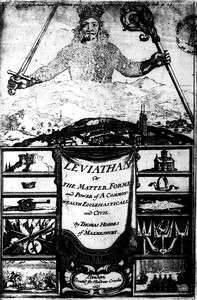
Leviathan by Thomas Hobbes

(4 User reviews)   5809
By Ronald Gonzalez Posted on Dec 25, 2025
In Category - Leadership
Hobbes, Thomas, 1588-1679 Hobbes, Thomas, 1588-1679
English
Imagine living in a world with no rules, no police, and no government. That's the scary starting point Thomas Hobbes asks us to consider in 'Leviathan'. Written in 1651 during England's civil war, this isn't a novel—it's a philosophical argument that feels shockingly urgent. Hobbes makes the case that without a powerful central authority to keep us in check, human life would be 'solitary, poor, nasty, brutish, and short.' His solution? We all agree to hand over our freedom to an all-powerful ruler, the 'Leviathan.' It's a controversial and chilling idea that asks the biggest question: is safety worth giving up our liberty?
Share

Read "Leviathan by Thomas Hobbes" Online

This book is available in the public domain. Start reading the digital edition below.

START READING FULL BOOK
Instant Access    Mobile Friendly

Book Preview

A short preview of the book’s content is shown below to give you an idea of its style and themes.

proper names, for quotations, and sometimes, it seems, just because. The original has very extensive margin notes, which are used to show where he introduces the definitions of words and concepts, to give in short the subject that a paragraph or section is dealing with, and to give references to his quotations, largely but not exclusively biblical. To some degree, these margin notes seem to have been intended to serve in place of an index, the original having none. They are all in italics. He also used italics for words in other languages than English, and there are a number of Greek words, in the Greek alphabet, in the text. To deal with these within the limits of plain vanilla ASCII, I have done the following in this E-text. I have restricted my use of full capitalization to those places where Hobbes used it, except in the chapter headings, which I have fully capitalized, where Hobbes used a mixture of full capitalization and italics. Where it is clear that the italics are to indicate the text is quoting, I have introduced quotation marks. Within quotation marks I have retained the capitalization that Hobbes used. Where italics seem to be used for emphasis, or for proper names, or just because, I have capitalized the initial letter of the words. This has the disadvantage that they are not then distinguished from those that Hobbes capitalized in plain text, but the extent of his italics would make the text very ugly if I was to use an underscore or slash. Where the margin notes are either to introduce the paragraph subject, or to show where he introduces word definitions, I have included them as headers to the paragraph, again with all words having initial capitals, and on a shortened line. For margin references to quotes, I have included them in the text, in brackets immediately next to the quotation. Where Hobbes included references in the main text, I have left them as he put them, except to change his square brackets to round. For the Greek alphabet, I have simply substituted the nearest ordinary letters that I can, and I have used initial capitals for foreign language words. Neither Thomas Hobbes nor his typesetters seem to have had many inhibitions about spelling and punctuation. I have tried to reproduce both exactly, with the exception of the introduction of quotation marks. In preparing the text, I have found that it has much more meaning if I read it with sub-vocalization, or aloud, rather than trying to read silently. Hobbes’ use of emphasis and his eccentric punctuation and construction seem then to work. TO MY MOST HONOR’D FRIEND Mr. FRANCIS GODOLPHIN of GODOLPHIN HONOR’D SIR. Your most worthy Brother Mr SIDNEY GODOLPHIN, when he lived, was pleas’d to think my studies something, and otherwise to oblige me, as you know, with reall testimonies of his good opinion, great in themselves, and the greater for the worthinesse of his person. For there is not any vertue that disposeth a man, either to the service of God, or to the service of his Country, to Civill Society, or private Friendship, that did not manifestly appear in his conversation, not as acquired by necessity, or affected upon occasion, but inhaerent, and shining in a generous constitution of his nature. Therefore in honour and gratitude to him, and with devotion to your selfe, I humbly Dedicate unto you this my discourse of Common-wealth. I know not how the world will receive it, nor how it may reflect on those that shall seem to favour it. For in a way...

This is a limited preview. Download the book to read the full content.

Okay, let's be clear: 'Leviathan' is not a beach read. It's a dense, 17th-century political manifesto. But if you can push through the old-fashioned language, you'll find one of the most influential arguments ever made about power and society.

The Story

There's no plot in the usual sense. Instead, Hobbes builds his case like a logical proof. He starts by imagining humans in a 'state of nature'—before governments existed. He argues we're all driven by fear and self-interest, leading to a constant war of 'every man against every man.' To escape this nightmare, he says, rational people would make a 'social contract.' We all surrender our natural rights to an absolute sovereign (the 'Leviathan'), who then has the power to make and enforce laws to keep the peace.

Why You Should Read It

Reading Hobbes is like watching the blueprint for modern politics being drawn. His ideas are the foundation for everything from our concept of the social contract to the need for a strong state. It's fascinating (and a bit terrifying) to see how he prioritizes order above all else, even individual freedom. You'll find yourself constantly arguing with him, which is the point! It forces you to question the very basics: Why do we have government? What do we owe it? What does it owe us?

Final Verdict

This is a challenging but essential book for anyone interested in politics, philosophy, or history. It's perfect for the curious reader who wants to understand where ideas like 'consent of the governed' came from, or for fans of dystopian stories who want to see the philosophical roots of control. Don't try to read it all in one go—take it slow, chapter by chapter, and let the big ideas sink in.


📜 Public Domain Content

You are viewing a work that belongs to the global public domain. You can copy, modify, and distribute it freely.

Emily Gonzalez
5 months ago

Good quality content.

Ethan Hill
1 year ago

A bit long but worth it.

John Martinez
3 months ago

Very interesting perspective.

Amanda Lee
2 months ago

Fast paced, good book.

5
5 out of 5 (4 User reviews )

Add a Review

Your Rating *
There are no comments for this eBook.
You must log in to post a comment.
Log in


Related eBooks