About 731 minutes
The Complete Plays of Gilbert and Sullivan — Themes and Context
Opera Performance
168,126 recorded words. 376 minutes difference from this book's estimate.
View Gutenberg source #808
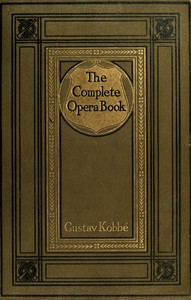
The source record for The Complete Opera Book The Stories of the Operas, together with 400 of the Leading Airs and Motives in Musical Notation — A Closer Reading measures this digital text at 254,570 words, 18 hr 27 min estimated reading time, and 41 detected text sections.
The text analysis averages about 17.6 words per sentence, while the detected sections provide another way to judge how the source is divided.
Project Gutenberg metadata also associates the work with “Operas -- Stories, plots, etc.,” connecting these edition facts with the source record’s subject description.
Explore this collection
These alternatives are selected using recorded categories and estimated reading time.
About 731 minutes
Opera Performance
168,126 recorded words. 376 minutes difference from this book's estimate.
View Gutenberg source #808About 597 minutes
Opera Performance
137,176 recorded words. 510 minutes difference from this book's estimate.
View Gutenberg source #24647About 528 minutes
Opera Performance
121,308 recorded words. 579 minutes difference from this book's estimate.
View Gutenberg source #28711Search stored excerpts and compare books → Choose by your preferences →
Choices use stored catalog measurements. Estimates vary with reading speed. A shared category is a catalog label, not a claim that two books have the same argument or literary quality.
Search reads excerpt text stored with this catalog and links to its associated Gutenberg record. The connection is stored in the site database; this tool does not recheck that every excerpt is word-for-word identical to that external record. Excerpt search does not cover every chapter and does not verify historical publication dates.
Catalog snapshot checked: 2026-09-25. Coverage: 90 public books, 90 available source excerpts.
Read the complete public-domain text at its original source.
Read on Project GutenbergGustav Kobbé's The Complete Opera Book (1919) interweaves narrative synopses with musical notation, offering over 400 leading airs and motives. The work's structure alternates between plot summary and technical commentary, as seen in the Aïda analysis where Kobbé dissects the Oriental scale's three-semitone interval in the sacred chant and dance. He traces the interval's appearance from G to F-flat and D to C-flat, noting its upward and downward tendencies.
The book's movement between scenes is deliberate: in Aïda, Act II shifts from Amneris's apartments to the triumphal gate at Thebes, each location framing a different dramatic tension. Kobbé's voice remains factual, avoiding personal opinion as noted in Katharine Wright's foreword.
Kobbé repeatedly highlights the interval of three semitones as characteristic of Oriental scales. In Aïda, he brackets the intervals in the sacred chant (D to C-flat) and sacred dance (G to F-flat), explaining that the ascending version sounds more familiar to Western ears because of the scale's upward tendency. He contrasts this with Oriental systems, where the scale tends downward. This technical observation recurs across multiple operas, serving as a structural thread. Kobbé does not merely describe the music; he uses the interval to argue about cultural perception of tonality. The same analytical lens appears in discussions of other works, though the excerpts limit full comparison.
The Aïda excerpt demonstrates Kobbé's method of moving between scenes to heighten emotional stakes. Act II opens in Amneris's hall, where she feigns sympathy and tests Aïda's feelings. The duet “Amore! gaudio tormento” encapsulates the princess's craftiness and Aïda's conflict. Then the scene shifts to the triumphal gate near the temple of Ammon, where the king sits under a purple canopy. Kobbé notes that Aïda is compelled to attend, intensifying her humiliation. This juxtaposition of private manipulation and public spectacle is a recurring pattern in the book, though the excerpts only show this example. The structural choice underscores how Verdi builds tension through location.
Kobbé maintains a detached, informative tone throughout. He writes that Amneris “craftily feigning sympathy” and “vents the refined cruelty of her jealous nature,” but avoids emotional commentary. The foreword by Katharine Wright confirms that Kobbé intended the work to stand on facts, not personal opinions. This voice is consistent: he describes the duet as “formulated by Verdi” and uses phrases like “what has just been described.” The narrative distance allows the plots and musical examples to speak for themselves. However, the excerpts are too brief to assess whether this tone persists across all 41 sections.
Kobbé embeds musical notation directly into the prose, with clickable [Listen] links in the e-book. In the Aïda analysis, he provides two music examples for the sacred chant and dance, bracketing the intervals. He also includes a phrase from the Amneris-Aïda duet, noting it expresses “combined haughtiness and jealousy.” This integration is not merely decorative; it supports his analytical claims. The book contains 400 such motives, making it a hybrid reference work. The notation serves as evidence for his structural observations, such as the Oriental scale. The excerpts do not reveal how many operas include notation, but the pattern is clear.
Readers approaching Kobbé's book should expect a methodical blend of plot summary and musical analysis. The 1919 first edition contains typographical errors, which this e-book corrects without note. The work's value lies in its specific observations—like the three-semitone interval—rather than broad interpretation. Use the table of contents to navigate by opera, and listen to the embedded MIDI files to hear the motives discussed.
Flipping through Kobbé’s old pages, I kept pausing on those printed motives, imagining the singers’ breath behind the dots. It felt less like reading and more like listening to someone hum a memory. That same unfinished, wondering quality surfaced later in Aspects of Modern Opera: Estimates and Inquiries — A Closer Reading, though its questions pointed forward, not back. Odd how one book can quietly hand you another, without ever saying a word.
Your answers remain private and are stored only in this browser.