About 597 minutes
The Standard Operaglass Detailed Plots of One Hundred and Fifty-one Celebrated Operas — Text and Context
Opera Performance
137,176 recorded words. 69 minutes difference from this book's estimate.
View Gutenberg source #24647
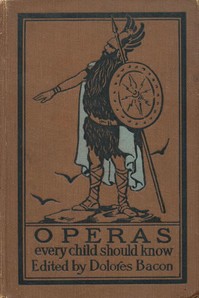
This digital edition of Operas Every Child Should Know Descriptions of the Text and Music of Some of the Most Famous Masterpieces — Inside the Classic is described by source-level measurements including 121,308 words, 8 hr 48 min estimated reading time, and 13 detected text sections.
The text analysis averages about 15.0 words per sentence, while the detected sections provide another way to judge how the source is divided.
Project Gutenberg metadata also associates the work with “Operas -- Stories, plots, etc.,” connecting these edition facts with the source record’s subject description.
Explore this collection
These alternatives are selected using recorded categories and estimated reading time.
About 597 minutes
Opera Performance
137,176 recorded words. 69 minutes difference from this book's estimate.
View Gutenberg source #24647About 379 minutes
Opera Performance
86,962 recorded words. 149 minutes difference from this book's estimate.
View Gutenberg source #5724About 731 minutes
Opera Performance
168,126 recorded words. 203 minutes difference from this book's estimate.
View Gutenberg source #808Search stored excerpts and compare books → Choose by your preferences →
Choices use stored catalog measurements. Estimates vary with reading speed. A shared category is a catalog label, not a claim that two books have the same argument or literary quality.
Search reads excerpt text stored with this catalog and links to its associated Gutenberg record. The connection is stored in the site database; this tool does not recheck that every excerpt is word-for-word identical to that external record. Excerpt search does not cover every chapter and does not verify historical publication dates.
Catalog snapshot checked: 2026-09-25. Coverage: 90 public books, 90 available source excerpts.
Read the complete public-domain text at its original source.
Read on Project GutenbergBacon's foreword immediately confronts the challenge of selection, noting that the operas included are not all great compositions—some are 'hopelessly poor.' This candor sets a practical tone: the book aims to give a complete idea of a few operas rather than a superficial sketch of many. The author includes works by Balfe and Flotow because they reflect popular taste in earlier generations, while Wagner's Ring cycle is chosen for its musical and story wonders, being 'the least understood.' The opening thus establishes a dual focus on historical context and narrative clarity.
Bacon's foreword reveals her editorial priorities directly. She admits the difficulty of leaving out operas like 'L'Africaine,' 'Othello,' or 'Parsifal,' but justifies her choices by aiming for depth over breadth. The inclusion of Balfe and Flotow is explicitly tied to their popularity with earlier audiences, not their artistic merit. This historical grounding is reinforced by a brief note on the origins of opera, tracing it to 1490 Italy and noting that Greek tragedies used music but not 'opera as we understand it.' The foreword also touches on ballet's French origins, mentioning that before 1681 only males performed female roles. These details frame the book as both a story collection and a cultural primer.
The excerpt on Verdi illustrates how Bacon weaves production history into her narratives. She recounts that Verdi kept the manuscript of 'La Donna è Mobile' from the tenor Mirate until the night before the orchestral rehearsal, demanding a promise that no one would hum or whistle the tune before the premiere. This anecdote underscores Verdi's confidence that the song would become an instant favorite—a faith justified when 'the whole country went “La Donna” mad.' Similarly, the story of 'Il Trovatore' includes the Tiber flooding Rome's streets, with audiences standing 'knee-deep in water' to buy tickets. These details give readers a sense of opera's social impact beyond the stage.
Bacon details the commissioned origin of 'Aïda,' written at the request of the Khedive Ismail Pacha for the Cairo opera house. Verdi initially named a price he thought would be refused, but when accepted, he became enthusiastic. The Egyptologist Mariette Bey was tasked with finding story materials, and the libretto underwent multiple translations: from French prose by Camille du Locle to Italian verse by Ghislanzoni, then back to French for the French stage. This layered process highlights the collaborative and international nature of opera production, a theme Bacon returns to throughout the book.
Bacon explicitly states that 'the music's the thing' in opera, not the play, yet her book prioritizes story summaries. She acknowledges that even the most heroic or touching stories lose dignity when set to music, but she compensates by telling the tales clearly. The excerpts show she includes musical cues—such as references to midi files in the original text—but her prose focuses on plot and character. For young readers, this approach makes complex operas like Wagner's Ring accessible without requiring musical training. The book's structure, with separate chapters for each opera, allows readers to dip into individual stories or read sequentially.
Bacon's book is best approached as a companion for first-time opera listeners who want to know what happens before they hear the music. The author's willingness to include lesser-known works alongside masterpieces offers a broader view of operatic history than a canon-focused guide would. Readers may find it useful to read the story of an opera before attending a performance or listening to a recording, letting Bacon's straightforward prose prepare them for the emotional arc of the music.
Of all the guides I’ve shelved, Bacon’s 1911Operas Every Child Should Know holds a special tenderness—its earnest wish to open Wagner and Verdi to young ears. It sits quietly beside The Operatic Problem — Themes and Context, a later, graver companion. One believes in the story’s power to enchant; the other wonders what stories we choose to keep singing. Together, they whisper of opera’s long, patient asking. A lovely, unspoken kinship.
Capture what you thought, learned, and would like to remember.