About 49 minutes
Parsifal: Story and Analysis of Wagner's Great Opera — Inside the Classic
Opera Performance
11,081 recorded words. 2 minutes difference from this book's estimate.
View Gutenberg source #20264
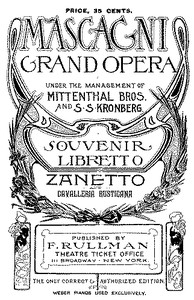
The catalog record for Zanetto; and Cavalleria Rusticana — Background and Themes provides practical reading context through 11,569 words, 51 min estimated reading time, and 3 detected text sections.
The text analysis averages about 11.7 words per sentence, while the detected sections provide another way to judge how the source is divided.
Project Gutenberg metadata also associates the work with “Operas -- Librettos,” connecting these edition facts with the source record’s subject description.
Explore this collection
These alternatives are selected using recorded categories and estimated reading time.
About 49 minutes
Opera Performance
11,081 recorded words. 2 minutes difference from this book's estimate.
View Gutenberg source #20264About 57 minutes
Opera Performance
13,000 recorded words. 6 minutes difference from this book's estimate.
View Gutenberg source #16250About 66 minutes
Opera Performance
14,968 recorded words. 15 minutes difference from this book's estimate.
View Gutenberg source #31963Search stored excerpts and compare books → Choose by your preferences →
Choices use stored catalog measurements. Estimates vary with reading speed. A shared category is a catalog label, not a claim that two books have the same argument or literary quality.
Search reads excerpt text stored with this catalog and links to its associated Gutenberg record. The connection is stored in the site database; this tool does not recheck that every excerpt is word-for-word identical to that external record. Excerpt search does not cover every chapter and does not verify historical publication dates.
Catalog snapshot checked: 2026-09-25. Coverage: 90 public books, 90 available source excerpts.
Read the complete public-domain text at its original source.
Read on Project GutenbergThis volume presents the librettos of two one-act operas by Pietro Mascagni, Zanetto and Cavalleria Rusticana, in both Italian and English translation by Willard G. Day. The excerpts show that the two works, though paired here, treat love in sharply different registers. Zanetto unfolds as a pastoral allegory: a wandering minstrel and a hostess named Silvia recognize each other as ideals, yet the plot summary warns that love, if not “frankly and honestly received,” may vanish. Cavalleria Rusticana, by contrast, is set on Easter morning in a Sicilian square, where Santuzza confronts Turiddu over his affair with the married Lola. The libretto’s language shifts from lyrical reflection to urgent, broken dialogue.
The catalog subject “Operas – Librettos” groups these works, but the excerpts reveal a stark contrast in dramatic mode. Zanetto opens with a plot summary that explicitly states its “allegorical sense”: the minstrel represents love, and Silvia’s hesitation causes his departure. The language is abstract—Silvia “recognizes in him her ideal”—and the action is minimal: a meeting, a refusal, a farewell. In Cavalleria Rusticana, however, the drama is immediate and social. Santuzza’s accusation, “You are lying; I saw you turning here into this street,” grounds the conflict in specific, observable actions. The Easter setting amplifies the irony: religious celebration frames betrayal and impending violence. While Zanetto uses love as a philosophical concept, Cavalleria treats it as a destructive force within a community.
In Cavalleria Rusticana, the chorus and setting are integral to the drama. The excerpts include choral passages in Italian: “Inneggiamo, il Signor non è morto” (Let us praise, the Lord is not dead), sung both inside and outside the church. This creates a spatial division—the sacred interior versus the secular square—that mirrors the moral tension. Alfio’s entrance with a cheerful song about his horse and his wife Lola (“M’aspetta a casa Lola che m’ama e mi consola”) contrasts sharply with Santuzza’s grief. The libretto uses these juxtapositions to heighten the irony: while the community celebrates resurrection, Santuzza laments her lost honor. In Zanetto, the setting is a solitary mountain hotel; the only “chorus” is Silvia’s internal reflection. The difference underscores how Cavalleria derives its power from collective ritual, while Zanetto depends on intimate, symbolic exchange.
The libretto is presented in facing English and Italian, with Willard G. Day’s translation aiming for singability and clarity. In Cavalleria Rusticana, Santuzza’s line “Priva dell’onor mio rimango” becomes “Despoiled of my honor I live on,” preserving the emotional weight while adjusting syntax. Day sometimes expands the original: where the Italian has “io piango” (I weep), the English adds “I weep, I weep, I weep,” intensifying the lament. In Zanetto, the plot summary is given only in English, suggesting the translation may prioritize narrative accessibility over literal fidelity. The bilingual format allows readers to compare Mascagni’s original Italian rhythms with Day’s English versions, revealing how the translator negotiates between poetic form and dramatic immediacy. This edition, published as a “Souvenir Libretto” by F. Rullman, also includes performance details, indicating its use as a program for early twentieth-century productions.
Readers approaching this volume should note that the librettos are not self-contained literary texts but performance documents. The plot summary for Zanetto provides an interpretive frame that the sung text may not fully support, while Cavalleria Rusticana relies on the audience’s familiarity with Easter traditions and Sicilian village life. Comparing the Italian and English versions reveals the translator’s choices, but the excerpts are incomplete; the full librettos may include additional scenes or musical directions. Treat these texts as scripts for the stage, where music and gesture complete the meaning.
Years at the desk have taught me how operas whisper to one another across the stacks. This libretto, with its twin faces of love—one celestial, one scorched—brings to mind the old Wagner collection nearby, where gods stumble through the same tangled human longing. Both volumes hold that ache, quietly patient on the shelf. Stories of the Wagner Opera — Text and Context shares that same sorrowful music, if one listens closely.
Save your reaction, strongest insight, and memorable passage.