About 51 minutes
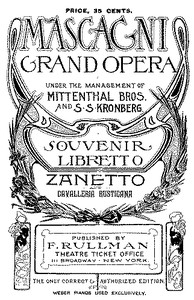
Zanetto; and Cavalleria Rusticana — Background and Themes
Opera Performance
11,569 recorded words. 6 minutes difference from this book's estimate.
View Gutenberg source #14370
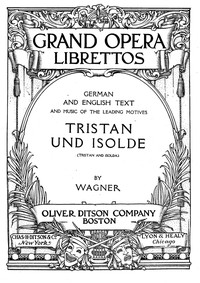
The source record for Tristan and Isolda: Opera in Three Acts — Context and Discussion measures this digital text at 13,000 words, 57 min estimated reading time, and 2 detected text sections.
The text analysis averages about 11.8 words per sentence, while the detected sections provide another way to judge how the source is divided.
Project Gutenberg metadata also associates the work with “Operas -- Librettos,” connecting these edition facts with the source record’s subject description.
Explore this collection
These alternatives are selected using recorded categories and estimated reading time.
About 51 minutes
Opera Performance
11,569 recorded words. 6 minutes difference from this book's estimate.
View Gutenberg source #14370About 49 minutes
Opera Performance
11,081 recorded words. 8 minutes difference from this book's estimate.
View Gutenberg source #20264About 66 minutes
Opera Performance
14,968 recorded words. 9 minutes difference from this book's estimate.
View Gutenberg source #31963Search stored excerpts and compare books → Choose by your preferences →
Choices use stored catalog measurements. Estimates vary with reading speed. A shared category is a catalog label, not a claim that two books have the same argument or literary quality.
Search reads excerpt text stored with this catalog and links to its associated Gutenberg record. The connection is stored in the site database; this tool does not recheck that every excerpt is word-for-word identical to that external record. Excerpt search does not cover every chapter and does not verify historical publication dates.
Catalog snapshot checked: 2026-09-25. Coverage: 90 public books, 90 available source excerpts.
Read the complete public-domain text at its original source.
Read on Project GutenbergThe libretto opens on a ship, a confined space that mirrors the characters' emotional entrapment. Isolda, buried in cushions, starts up at a sailor's song, demanding to know where they sail. Brangæna's reply—"Bluish stripes are stretching along the west"—offers a glimpse of approaching land, but Isolda's response, "Never more! To-day nor to-morrow!" immediately establishes her resistance. The ship is not merely a vessel but a threshold between Ireland and Cornwall, between Isolda's former power and her future as a bride. This opening scene, with its interplay of sea, sky, and cabin, sets up a pattern of confinement and longing that runs through the entire work.
The libretto repeatedly contrasts daylight with night, associating day with duty, betrayal, and pain, and night with truth, love, and release. In Act II, Tristan cries out against "Daylight phantoms— morning visions empty and vain— Avaunt! Begone!" He describes the land he means to go to as "the dark abode of night, from whence I first came forth to light." Isolda, in turn, declares she will follow him to that kingdom. This opposition is not merely poetic; it structures the characters' desires and their ultimate fate. The love potion itself, which ignites their passion, is a force that operates outside the social order of daylight, leading them toward a union that can only be fulfilled in death.
Betrayal is a central theme, but the libretto presents it in layered, ambiguous ways. Tristan is called "traitor" by Isolda and later by King Mark, yet he also accuses his friend Melot of playing him false. King Mark's long speech in Act II dwells on the paradox: "Where now has truth fled, if Tristan can betray?" He lists Tristan's services—winning realms, urging the king to marry—and asks why such honor should be repaid with dishonor. Tristan's response, "I— may not tell thee, truly; what thou dost ask remains for aye unanswered," suggests that the betrayal is not a simple act but a consequence of forces—the potion, love, fate—that cannot be explained. Melot, who initially appears as Tristan's friend, becomes the agent of exposure, driven by jealousy.
Physical and emotional wounds permeate the text. Tristan is mortally wounded in Act II, and in Act III his faithful servant Kurvenal carries him to Brittany, where Isolda is sent for because she is "skilled above all others in the healing art." Yet her arrival hastens his death. The libretto uses wound imagery metaphorically as well: King Mark speaks of "anguish and disgrace," and Tristan's betrayal is described as a blow. The love potion itself is a kind of wound—it inflames passion beyond restraint, leading to destruction. The shepherd's pipe and the steersman's calls in Act III underscore the tension between hope and despair, as the characters await a healing that never fully comes.
Readers approaching this libretto should attend to the stage directions and the musical motives indicated in the text, as they carry dramatic weight. The English translation, while sometimes archaic, preserves the rhythmic intensity of Wagner's verse. Notice how characters often speak in short, exclamatory lines or in extended, lyrical speeches—the contrast itself is a kind of music. The story is told in three acts, each centered on a different location: the ship, the castle, and the Breton refuge. These spaces are not backdrops but active elements in the drama of love and death.
That shipboard scene in Tristan and Isolda—the way daylight forces their hands while night whispers what they truly feel—took me straight back to my grandfather’s armchair, reading Opera Stories from Wagner — Reading Notes aloud. The same ache of duty strangling desire, the same doomed glance across a deck. I remember closing that old book, staring at the ceiling, feeling the potion’s weight settle in my own gut.
Build a private reading journal entry for this title.