About 100 minutes
Aspects of Modern Opera: Estimates and Inquiries — A Closer Reading
Opera Performance
22,782 recorded words. 6 minutes difference from this book's estimate.
View Gutenberg source #38268
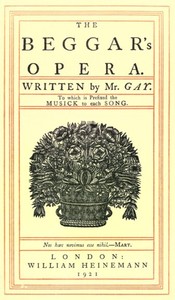
The catalog record for The Beggar's Opera; to Which is Prefixed the Musick to Each Song — Story, Setting & Ideas provides practical reading context through 24,293 words, 1 hr 46 min estimated reading time, and 5 detected text sections.
The text analysis averages about 15.5 words per sentence, while the detected sections provide another way to judge how the source is divided.
Project Gutenberg metadata also associates the work with “Ballad operas -- Librettos,” connecting these edition facts with the source record’s subject description.
Explore this collection
These alternatives are selected using recorded categories and estimated reading time.
About 100 minutes
Opera Performance
22,782 recorded words. 6 minutes difference from this book's estimate.
View Gutenberg source #38268About 84 minutes
Opera Performance
19,292 recorded words. 22 minutes difference from this book's estimate.
View Gutenberg source #34302About 70 minutes
Opera Performance
15,900 recorded words. 36 minutes difference from this book's estimate.
View Gutenberg source #9456Search stored excerpts and compare books → Choose by your preferences →
Choices use stored catalog measurements. Estimates vary with reading speed. A shared category is a catalog label, not a claim that two books have the same argument or literary quality.
Search reads excerpt text stored with this catalog and links to its associated Gutenberg record. The connection is stored in the site database; this tool does not recheck that every excerpt is word-for-word identical to that external record. Excerpt search does not cover every chapter and does not verify historical publication dates.
Catalog snapshot checked: 2026-09-25. Coverage: 90 public books, 90 available source excerpts.
Read the complete public-domain text at its original source.
Read on Project GutenbergJohn Gay's The Beggar's Opera (1728) opens not with a conventional overture but with a Beggar and a Player debating the work's form—a meta-theatrical frame that immediately signals the opera's self-aware satire. The 1921 edition edited by Claud Lovat Fraser, with a preface by John Drinkwater, restores the original music to each song and includes color plates placed between scenes. Fraser's note explains that the text follows the 1765 edition, with scenes renumbered to reflect actual changes of place or intervals of time. This editorial choice clarifies the original staging while preserving the period flavor.
The work begins with a Beggar and a Player discussing the opera's structure. The Player objects that the piece is too sentimental, lacking the expected 'jail-birds' and 'low-life' characters. This exchange, unique to Gay's opera, sets up a tension between the audience's expectations and the work's actual content. The Beggar insists on a 'gentle' ending, hinting at the opera's subversion of conventional morality. Readers should note how this framing device colors every subsequent scene, reminding us that the opera is a deliberate construction, not a naturalistic portrayal.
In Act I, Scene I, Peachum, a fence and informer, delivers a soliloquy that reveals his calculating nature: 'A lawyer is an honest employment, so is mine.' He weighs the profit of betraying his own gang members against the risk of losing their services. His wife, Mrs. Peachum, is equally pragmatic, worrying about their daughter Polly's marriage to the highwayman Macheath. The dialogue is laced with ironic comparisons between crime and commerce, as when Peachum notes that 'the world is all alike, and that every man is a rascal in his own way.' This cynical worldview underpins the opera's satire.
In Act II, Scene II, Macheath is imprisoned in Newgate and confronted by Lucy Lockit, whom he has promised to marry. His attempts to placate her reveal his manipulative charm: 'What signifies a Promise to a Woman? Does not Man in Marriage itself promise a hundred things that he never means to perform?' Lucy's response, set to the air 'A lovely Lass to a Friar came,' compares her desire for revenge to a housewife's glee at catching a rat. The scene showcases Gay's use of popular tunes to underscore emotional states, with Macheath's glibness contrasting sharply with Lucy's fury.
Fraser's edition includes the music for each song, printed with staff notation and MIDI/PDF versions. The color plates, such as 'Mrs. Peachum' and 'Captain Macheath,' are placed between scenes, offering visual interpretations that may influence how readers imagine the characters. The List of Plates shows their original locations, allowing readers to see where the illustrator intended them to appear. Pay attention to how the songs interrupt or advance the action; for example, Macheath's air 'The first time at the Looking-glass' comments on female vanity, echoing the opera's broader critique of social pretensions.
As you read, note how the Beggar's opening promise of a 'gentle' ending contrasts with the gallows humor and moral ambiguity that follow. The opera's structure—alternating dialogue with songs—creates a rhythm that rewards attention to both the lyrics and the spoken lines. Fraser's edition, with its careful scene numbering and musical notation, invites you to experience the work as a performance text, not merely a literary artifact.
Holding this edition, I recalled winter evenings spent listening to my grandmother hum “Over the Hills and Far Away” while shelling peas. Macheath’s swagger felt less like satire then, more like the stubborn joy of people who have little else. Aspects of Modern Opera: Estimates and Inquiries — A Closer Reading once gave me that same ache—opera’s grand gestures collapsing into something tenderly human, waiting quietly behind the noise.
Create a short personal record of your experience with this book.