About 225 minutes
Contemporary Composers — Edition Insights
Composers
51,640 recorded words. 3 minutes difference from this book's estimate.
View Gutenberg source #56593
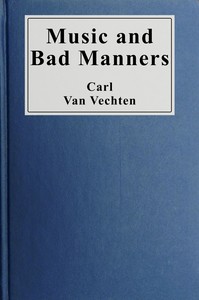
For Music and bad manners — Inside the Classic, the stored edition analysis reports 50,948 words, 3 hr 42 min estimated reading time, and 13 detected text sections.
The text analysis averages about 23.2 words per sentence, while the detected sections provide another way to judge how the source is divided.
Project Gutenberg metadata also associates the work with “Composers,” connecting these edition facts with the source record’s subject description.
Explore this collection
These alternatives are selected using recorded categories and estimated reading time.
About 225 minutes
Composers
51,640 recorded words. 3 minutes difference from this book's estimate.
View Gutenberg source #56593About 232 minutes
Composers
53,286 recorded words. 10 minutes difference from this book's estimate.
View Gutenberg source #35812About 242 minutes
Composers
55,634 recorded words. 20 minutes difference from this book's estimate.
View Gutenberg source #20571Search stored excerpts and compare books → Choose by your preferences →
Choices use stored catalog measurements. Estimates vary with reading speed. A shared category is a catalog label, not a claim that two books have the same argument or literary quality.
Search reads excerpt text stored with this catalog and links to its associated Gutenberg record. The connection is stored in the site database; this tool does not recheck that every excerpt is word-for-word identical to that external record. Excerpt search does not cover every chapter and does not verify historical publication dates.
Catalog snapshot checked: 2026-09-25. Coverage: 90 public books, 90 available source excerpts.
Read the complete public-domain text at its original source.
Read on Project GutenbergCarl Van Vechten begins his 1916 collection with a deliberately provocative claim: “Singers, musicians of all kinds, are notoriously bad mannered.” He immediately supports this with a cascade of anecdotes—Beethoven’s storms, Wagner’s malevolences, Chopin’s suffocating displeasure—and a memorable image of a soprano hurling a pork roast to the floor before a performance of Parsifal. The essay’s title, “Music and Bad Manners,” sets the tone for a volume that treats musical culture with irreverent wit and sharp observation.
Van Vechten extends his critique to audiences, noting their “unduly calm” tolerance of inadequate performances, while confessing his own impulse to “throw the first stone” at a disastrous ballet. This opening establishes a voice that is at once scholarly and conversational, blending biography, criticism, and personal opinion.
The opening essay builds its case through a series of vivid, often comic, examples. Van Vechten cites George Sand on Chopin—“in displeasure was appalling”—and describes a soprano who declared “Pork before Parsifal!” as she flung a roast. These stories are not mere gossip; they serve to illustrate a broader argument about the gap between public performance and private behavior. The author notes that on stage, artists become “superhuman beings,” while at home they may be “ruthless in their passionate display of floods of ‘temperament.’” This distinction between the controlled virtuoso and the volatile private individual recurs throughout the collection, inviting readers to consider how much of musical genius is inseparable from personal eccentricity.
Van Vechten turns his attention to the audience, arguing that listeners are “unreasonably polite” to inadequate performances. He recalls sitting through a Russian Symphony Society concert in New York, wondering at his fellow sufferers’ patience. The essay suggests that audiences, like performers, have a role in shaping musical culture—their silence or applause can either encourage mediocrity or demand excellence. Van Vechten’s own willingness to criticize, as when he found the ballet in Prince Igor “danced in defiance of all laws of common sense or beauty,” positions him as a discerning listener who values honesty over decorum. This section sets up a recurring tension between social politeness and artistic integrity.
In “Spain and Music,” Van Vechten examines the relationship between Spanish folk dance and composed works. He observes that Goyescas, like many zarzuelas, “lags when the dance rhythms cease,” and confesses little joy in its famous “La Maja y el Ruiseñor.” Instead, he praises Granados’s four volumes of Spanish dances for piano, which “combine in their artistic form all the elements of the folk-dances.” The essay provides a biographical sketch of Granados—born 1867, died 1916 as a passenger on the torpedoed Sussex—and notes his study under Felipe Pedrell. Van Vechten’s preference for the dances over the opera reveals his critical eye: he values rhythmic vitality and folk authenticity over ambitious but uneven stage works.
In “Shall We Realize Wagner’s Ideals?” Van Vechten argues that Wagner’s operas are becoming “old-fashioned,” with Lohengrin and Tannhäuser “a trifle shop-worn.” He contrasts them with the “real thrill” of Moussorgsky’s Boris Godunow, which makes it “difficult to feel the intensity of a Wagner drama again.” The essay critiques the Metropolitan Opera’s adherence to “Die Bayreuther Tradition,” which Van Vechten sees as a misunderstanding of Wagner’s own wishes. He calls for a fresh approach to staging and performance, suggesting that Wagner’s music deserves better than the routine productions it often receives. This piece exemplifies Van Vechten’s willingness to challenge sacred cows and his belief that opera must evolve to remain vital.
Van Vechten’s essays reward readers who enjoy a critic willing to name names and break taboos. The collection moves from broad cultural commentary to focused analysis of specific works and figures, always grounded in concrete examples. Readers may find it useful to read the essays in order, as the opening manifesto on bad manners provides a lens through which to view the later discussions of Spanish music, Wagner, and emerging composers like Leo Ornstein. The author’s voice—opinionated, erudite, and occasionally irreverent—makes this a lively companion for anyone interested in early twentieth-century musical culture.
There’s something tender about Van Vechten’s grumpy musicians, those legends caught mid-tantrum. It makes me think of the quieter programs in The Masters and Their Music A series of illustrative programs with biographical, esthetical, and critical annotations — A Closer Reading, where the same tempers settle into careful notes. I suppose bad manners and beauty were always neighbors.
Answer a few questions and save a private reflection on this device.