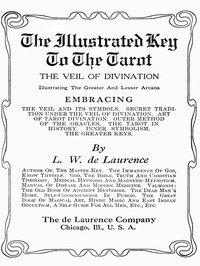
The Illustrated Key to the Tarot: The Veil of Divination by L. W. De Laurence

(27 User reviews)   7120
By Ronald Gonzalez Posted on Dec 25, 2025
In Category - Leadership
De Laurence, L. W. (Lauron William), 1868-1936 De Laurence, L. W. (Lauron William), 1868-1936
English
Ever wonder where those classic Rider-Waite-Smith tarot images you see everywhere actually came from? This book holds a weird piece of the puzzle. It's not your modern guide to card meanings. Instead, it's a strange and controversial reprint of an earlier occult work, wrapped in the story of its publisher, L.W. De Laurence. He was a figure accused of everything from plagiarism to mail fraud, selling 'secrets' to early 20th-century seekers. Reading this is less about learning tarot and more about uncovering a slice of occult history that's equal parts fascinating, murky, and a little bit shady. It's a trip back to when esoteric knowledge was a commodity, sold by mail order.
Share

Read "The Illustrated Key to the Tarot: The Veil of Divination by L. W. De Laurence" Online

This book is available in the public domain. Start reading the digital edition below.

START READING FULL BOOK
Instant Access    Mobile Friendly

Book Preview

A short preview of the book’s content is shown below to give you an idea of its style and themes.

some of more real consequence, seeing that their dedications are mine. To these and to any I would say that after the most illuminated Frater Christian Rosy Cross had beheld the Chemical Marriage in the Secret Palace of Transmutation, his story breaks off abruptly, with an intimation that he expected next morning to be door-keeper. After the same manner, it happens more often than might seem likely that those who have seen the _Occult Powers_ of Nature through the most clearest veils of the sacraments are those who assume thereafter the humblest offices of all about the House of Wisdom. By such simple devices also are the _Adepts_ and _Great Masters_ in the secret orders distinguished from the cohort of Neophytes as _servi servorum mysterii_. So also, or in a way which is not entirely unlike, we meet with the Tarot cards at the outermost gates--amidst the fritterings and débris of the so called _occult_ arts, about which no one in their senses has suffered the smallest deception; and yet these cards belong in themselves to another region, for they contain a very high symbolism, which is interpreted according to the Laws of Grace rather than by the pretexts and intuitions of that which passes for divination. The fact that the wisdom of God (Nature) is foolishness with men does not create a presumption that the foolishness of this world makes in any sense for Divine Wisdom; so neither the scholars in the ordinary classes nor the pedagogues in the seats of the mighty will be quick to perceive the likelihood or even the possibility of this proposition. The subject has been in the hands of cartomancists as part of the stock-in-trade of their industry; I do not seek to persuade any one outside my own circles that this is of much or of no consequence; but on the historical and interpretative sides it has not fared better; it has been there in the hands of exponents who have brought it into utter contempt for those people who possess philosophical insight or faculties for the appreciation of evidence. It is time that it should be rescued, and this I propose to undertake once and for all, that I may have done with the side issues which distract from the term. As poetry is the most beautiful expression of the things that are of all most beautiful, so is symbolism the most catholic expression in concealment of things that are most profound in the Sanctuary and that have not been declared outside it with the same fullness by means of the spoken word. The justification of the rule of silence is no part of my present concern, but I have put on record elsewhere, and quite recently, what it is possible to say on this subject. * * * * * The little treatise which follows is divided into three parts, in the first of which I have dealt with the antiquities of the subject and a few things that arise from and connect therewith. It should be understood that it is not put forward as a contribution to the history of playing cards, about which I know and care nothing; it is a consideration dedicated and addressed to a certain school of occultism, more especially in France, as to the source and center of all the phantasmagoria which has entered into expression during the last fifty years under the pretense of considering Tarot cards historically. In the second part, I have dealt with the symbolism according to some of its higher aspects, and this also serves to introduce the complete...

This is a limited preview. Download the book to read the full content.

Let's be clear upfront: this isn't a straightforward storybook. The Illustrated Key to the Tarot: The Veil of Divination is a historical artifact. The 'plot' here is the book's own existence. It presents itself as a guide to the tarot, with descriptions and classic illustrations, but it's largely a repackaging of A.E. Waite's earlier work. The real narrative is about its publisher, L.W. De Laurence. In the early 1900s, he built an empire by selling books on magic, mail-order courses, and mysterious 'occult supplies' to a public hungry for hidden knowledge.

Why You Should Read It

You won't find deep character studies here, but you will meet De Laurence himself—a character of history who feels almost fictional. Reading his introductions, which promise profound secrets to those who buy his products, is a unique experience. It gives you a direct look into the business of the occult a century ago. The book's value isn't as a tarot manual (there are better modern ones), but as a primary source. It shows how spiritual ideas were commercialized and how people sought meaning and power through these published 'keys.'

Final Verdict

This is a niche read, but a compelling one. It's perfect for history buffs and tarot enthusiasts who want to look beyond card meanings and understand the sometimes-odd journey of esoteric knowledge into the mainstream. If you love the strange backstories of things, or are curious about early 20th-century pop culture and self-help, you'll find this fascinating. Just don't buy it expecting a clear, modern guide to reading cards. Buy it to hold a curious piece of the past in your hands.


📢 Copyright Free

This historical work is free of copyright protections. You are welcome to share this with anyone.

Ethan Miller
11 months ago

This is one of those stories where the plot twists are genuinely surprising. I couldn't put it down.

Mary Williams
8 months ago

Finally found time to read this!

Paul Thomas
2 months ago

Wow.

Edward Davis
1 year ago

Citation worthy content.

Lucas Wilson
1 year ago

As someone who reads a lot, the arguments are well-supported by credible references. Worth every second.
4.5
4.5 out of 5 (27 User reviews )

Add a Review

Your Rating *
There are no comments for this eBook.
You must log in to post a comment.
Log in


Related eBooks