About 70 minutes
Opera Stories from Wagner — Reading Notes
Opera Performance
15,900 recorded words. 1 minutes difference from this book's estimate.
View Gutenberg source #9456
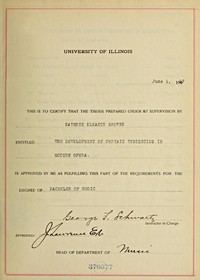
The catalog record for The Development of Certain Tendencies in Modern Opera Thesis for the degree of Bachelor of Music — Background and Themes provides practical reading context through 15,800 words, 1 hr 9 min estimated reading time, and 3 detected text sections.
The text analysis averages about 13.4 words per sentence, while the detected sections provide another way to judge how the source is divided.
Project Gutenberg metadata also associates the work with “Opera,” connecting these edition facts with the source record’s subject description.
Explore this collection
These alternatives are selected using recorded categories and estimated reading time.
About 70 minutes
Opera Performance
15,900 recorded words. 1 minutes difference from this book's estimate.
View Gutenberg source #9456About 66 minutes
Opera Performance
14,968 recorded words. 3 minutes difference from this book's estimate.
View Gutenberg source #31963About 57 minutes
Opera Performance
13,000 recorded words. 12 minutes difference from this book's estimate.
View Gutenberg source #16250Search stored excerpts and compare books → Choose by your preferences →
Choices use stored catalog measurements. Estimates vary with reading speed. A shared category is a catalog label, not a claim that two books have the same argument or literary quality.
Search reads excerpt text stored with this catalog and links to its associated Gutenberg record. The connection is stored in the site database; this tool does not recheck that every excerpt is word-for-word identical to that external record. Excerpt search does not cover every chapter and does not verify historical publication dates.
Catalog snapshot checked: 2026-09-25. Coverage: 90 public books, 90 available source excerpts.
Read the complete public-domain text at its original source.
Read on Project GutenbergKathryn Eleanor Browne’s 1917 thesis for the University of Illinois takes a strikingly empirical approach to opera history. Rather than offering aesthetic judgments or harmonic analysis, she counts measures—literally—to track how the proportions of solos, ensembles, choruses, recitative, and orchestral passages changed from Gluck through Wagner and into the early Russian school. The result is a document that reads like a laboratory notebook for musicology, complete with seven tables that break down percentages for each of the 34 operas studied.
Browne’s method is both her strength and her limitation: she treats opera as a set of measurable components, leaving aside the expressive content that those components serve. Yet her data-driven perspective reveals patterns that purely descriptive histories might miss, such as the gradual expansion of orchestral function and the shifting balance between solo and ensemble writing.
Browne’s introduction makes her method explicit: she will examine “the differences in regard to; (1) the number of acts employed; (2) the number and kind of characters; (3) a comparison; (a) of the proportion of orchestral work, overtures, ballets and ritornelli; (b) of solo work and the various voices employed; (c) of recitative, spoken, accompanied and unaccompanied; (d) of ensemble work, duets, trios, quartets, quintets and sextets; and (e) … the proportion of chorus work.” The seven tables at the end of the thesis are the core of her evidence, each one showing percentages derived from “actual count of the measures.” This quantitative lens is unusual for its time and gives the work a distinctive, almost scientific character.
Her approach has clear limits: she acknowledges that she has not attempted “harmonic analysis,” and the excerpts show that her commentary on individual operas is often brief and evaluative rather than analytical. For instance, she notes that Verdi’s Falstaff exhibits “complete independence of restrictive formalism,” but she does not explain how the measure counts support that claim. The tables themselves are not reproduced in the excerpts, so the reader must take Browne’s word for the patterns she describes.
Browne devotes considerable attention to Russian composers, whom she groups under the “Post Wagnerian School.” She identifies Glinka as the “Father of Russian Opera,” praising his combination of Italian and German technique with Russian folk song and his use of “five-four, six-four and seven-four time.” Her discussion of Tchaikovsky’s Pique Dame notes that the orchestra is “more of a function than an accompaniment,” a phrase that echoes her broader interest in the changing role of the orchestra.
Her treatment of Rimski-Korsakov is particularly detailed. She observes that his Snow Maiden is “a trifle old-fashioned” and that he “cannot seem to decide whether opera is lyrical or symphonic.” She also points out that in Boris Godonnow there is “no principle tenor part, no principle contralto part and no principle soprano part,” making it “more for chorus.” These observations are grounded in the structural categories she has defined, but they also reveal her critical judgments about what makes an opera successful.
Browne’s thesis is valuable as a historical document of musicological method, but its conclusions are constrained by its own framework. By focusing exclusively on formal proportions, she cannot address why certain structural choices were made or how they affect the dramatic impact of an opera. For example, she notes that Wagner “laid down the theories but his imitators have failed because they did not have his genius,” a statement that relies on unmeasured qualities like genius rather than on her tables.
The excerpts also contain occasional errors in spelling and punctuation, which the transcriber has preserved “for authenticity.” These minor flaws do not undermine the thesis’s core argument, but they remind the reader that this is a student work, not a polished publication. Browne’s real contribution is her attempt to bring quantitative rigor to a field that had largely relied on qualitative description.
Readers approaching Browne’s thesis should keep in mind that it is a bachelor’s degree submission from 1917, not a comprehensive history. The tables that form its backbone are not included in the excerpts, so the argument must be taken largely on faith. Still, the document offers a fascinating glimpse into early musicological methods and a data-driven perspective on opera’s evolution that remains unusual even today. For those interested in how scholars have tried to measure art, this thesis is a curious and instructive artifact.
I was thinking today about how that old 1917 thesis, with its patient measure-by-measure tables, felt like someone listening very closely—counting the seams of opera’s architecture. It made me recall, softly, the pleasure of Opera Stories from Wagner — Reading Notes, which listens just as closely, but to the stories underneath the notes. Different textures, but the same quiet attention.
Answer a few questions and save a private reflection on this device.