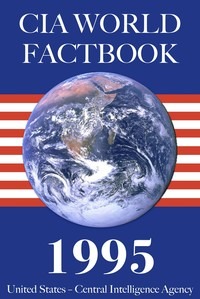
The 1995 CIA World Factbook by United States. Central Intelligence Agency

(5 User reviews)   4698
By Ronald Gonzalez Posted on Dec 25, 2025
In Category - Business
United States. Central Intelligence Agency United States. Central Intelligence Agency
English
Okay, hear me out. I know the title sounds like something you'd find in a dusty government basement, but trust me, this isn't a dry report. It's a time capsule. The 1995 CIA World Factbook is a snapshot of the world at a crazy moment—right after the Cold War ended, just as the internet was taking off. It shows us what the most powerful intelligence agency on Earth thought was important to know about every country. It's full of strange, specific details and glaring omissions that tell their own story. Reading it feels like finding a secret map to a world that's just vanished.
Share

Read "The 1995 CIA World Factbook by United States. Central Intelligence Agency" Online

This book is available in the public domain. Start reading the digital edition below.

START READING FULL BOOK
Instant Access    Mobile Friendly

Book Preview

A short preview of the book’s content is shown below to give you an idea of its style and themes.

coastlines, excluding inland water bodies (lakes, reservoirs, rivers). Comparative areas are based on total area equivalents. Most entities are compared with the entire US or one of the 50 states. The smaller entities are compared with Washington, DC (178 sq km, 69 sq mi) or The Mall in Washington, DC (0.59 sq km, 0.23 sq mi, 146 acres). Birth rate: The average annual number of births during a year per 1,000 population at midyear; also known as crude birth rate. Dates of information: In general, information available as of 1 January 1995 is used in the preparation of this edition. Population figures are estimates for 1 July 1995, with population growth rates estimated for calendar year 1995. Major political events have been updated through April 1995. Death rate: The average annual number of deaths during a year per l,000 population at midyear; also known as crude death rate. Digraphs: The digraph is a two-letter "country code" that precisely identifies every entity without overlap, duplication, or omission. AF, for example, is the digraph for Afghanistan. It is a standardized geopolitical data element promulgated in the Federal Information Processing Standards Publication (FIPS) 10-3 by the National Bureau of Standards (now called National Institute of Standards and Technology) at the US Department of Commerce and maintained by the Office of the Geographer at the US Department of State. The digraph is used to eliminate confusion and incompatibility in the collection, processing, and dissemination of area-specific data and is particularly useful for interchanging data between databases. Diplomatic representation: The US Government has diplomatic relations with 184 nations, including 178 of the 185 UN members (excluded UN members are Bhutan, Cuba, Iran, Iraq, North Korea, former Yugoslavia, and the US itself). In addition, the US has diplomatic relations with 6 nations that are not in the UN - Holy See, Kiribati, Nauru, Switzerland, Tonga, and Tuvalu. Economic aid: This entry refers to bilateral commitments of official development assistance (ODA) and other official flows (OOF). ODA is defined as financial assistance which is concessional in character, has the main objective to promote economic development and welfare of LDCs, and contains a grant element of at least 25%. OOF transactions are also official government assistance, but with a main objective other than development and with a grant element less than 25%. OOF transactions include official export credits (such as Ex-Im Bank credits), official equity and portfolio investment, and debt reorganization by the official sector that does not meet concessional terms. Aid is considered to have been committed when agreements are initialed by the parties involved and constitute a formal declaration of intent. Entities: Some of the nations, dependent areas, areas of special sovereignty, and governments included in this publication are not independent, and others are not officially recognized by the US Government. "Nation" refers to a people politically organized into a sovereign state with a definite territory. "Dependent area" refers to a broad category of political entities that are associated in some way with a nation. Names used for page headings are usually the short-form names as approved by the US Board on Geographic Names. There are 266 entities in The World Factbook that may be categorized as follows: NATIONS 184 -- UN members (excluding the former Yugoslavia, which is still counted by the UN) 7 -- nations that are not members of the UN--Holy See, Kiribati, Nauru, Serbia and Montenegro, Switzerland, Tonga, Tuvalu OTHER 1 -- Taiwan DEPENDENT AREAS 6 -- Australia--Ashmore and Cartier Islands, Christmas Island, Cocos (Keeling) Islands, Coral Sea Islands, Heard Island and McDonald Islands, Norfolk Island 2 -- Denmark--Faroe Islands, Greenland 16...

This is a limited preview. Download the book to read the full content.

Let's be clear from the start: this isn't a novel. There's no plot twist on page 47. The 1995 CIA World Factbook is exactly what it says it is—a massive, data-driven profile of every recognized country on Earth as it existed in 1995. Each entry follows a rigid template: geography, people, government, economy, communications, and defense. You get numbers for population, GDP, and railway mileage. You learn about ethnic groups, major exports, and the length of a nation's coastline. It's raw, unfiltered information presented without commentary.

Why You Should Read It

This is where it gets fascinating. Reading this book today is a wild exercise in time travel. You're seeing the world through the lens of a pre-9/11, pre-social media superpower. Yugoslavia is still one entry, painfully detailed just before its final breakup. The internet is a tiny subsection under 'Communications.' You can feel the focus shifting from purely military concerns to economic ones. The real story isn't in any single fact, but in the collective picture it paints—a planet frozen in a moment of uncertain transition. It’s history written by spreadsheet.

Final Verdict

This is a book for the deeply curious. It's perfect for history nerds, data lovers, and anyone who enjoys primary sources. If you're writing a novel set in the 90s, this is your bible. If you love comparing 'then vs. now,' you'll spend hours cross-referencing. It's not a cover-to-cover read; it's a book to dip into, to get lost in the weird specifics. Think of it less as a book and more as an artifact—a user's manual for a world that doesn't exist anymore.


📜 Copyright Status

This text is dedicated to the public domain. Distribute this work to help spread literacy.

Emily Sanchez
1 year ago

Loved it.

Jennifer Robinson
1 year ago

Clear and concise.

Edward King
1 year ago

Surprisingly enough, the narrative structure is incredibly compelling. This story will stay with me.

Noah Davis
1 year ago

Having read this twice, the atmosphere created is totally immersive. Thanks for sharing this review.

Karen Hill
1 year ago

Not bad at all.

5
5 out of 5 (5 User reviews )

Add a Review

Your Rating *
There are no comments for this eBook.
You must log in to post a comment.
Log in


Related eBooks