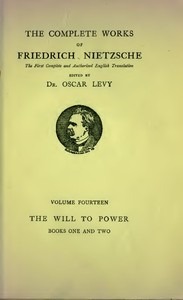
The Will to Power: An Attempted Transvaluation of All Values. Book I and II

(7 User reviews)   5907
By Ronald Gonzalez Posted on Dec 25, 2025
In Category - Business
Nietzsche, Friedrich Wilhelm, 1844-1900 Nietzsche, Friedrich Wilhelm, 1844-1900
English
Imagine being handed the raw, unfiltered notes of one of history's most provocative thinkers. That's 'The Will to Power.' This isn't a polished book, but a collection of Friedrich Nietzsche's final ideas, compiled after his mental collapse. It's a messy, explosive, and deeply challenging look at his core concept: that the fundamental drive in all life isn't survival, but a craving for power and expansion. He takes aim at everything—Christianity, democracy, traditional morality—arguing they are 'slave' values that crush human potential. Reading this is like witnessing a philosophical volcano erupt. It will unsettle you, infuriate you, and maybe even change how you see your own motivations. Are you ready for that?
Share

Read "The Will to Power: An Attempted Transvaluation of All Values. Book I and II" Online

This book is available in the public domain. Start reading the digital edition below.

START READING FULL BOOK
Instant Access    Mobile Friendly

Book Preview

A short preview of the book’s content is shown below to give you an idea of its style and themes.

Unfortunately, _The Will to Power_ was never completed by its author. The text from which this translation was made is a posthumous publication, and it suffers from all the disadvantages that a book must suffer from which has been arranged and ordered by foster hands. When those who were responsible for its publication undertook the task of preparing it for the press, it was very little more than a vast collection of notes and rough drafts, set down by Nietzsche from time to time, as the material for his chief work; and, as any liberty taken with the original manuscript, save that of putting it in order, would probably have resulted in adding or excluding what the author would on no account have added or excluded himself, it follows that in some few cases the paragraphs are no more than hasty memoranda of passing thoughts, which Nietzsche must have had the intention of elaborating at some future time. In these cases the translation follows the German as closely as possible, and the free use even of a conjunction has in certain cases been avoided, for fear lest the meaning might be in the slightest degree modified. It were well, therefore, if the reader could bear these facts in mind whenever he is struck by a certain clumsiness, either of expression or disposition, in the course of reading this translation. It may be said that, from the day when Nietzsche first recognised the necessity of making a more unequivocal appeal to his public than the _Zarathustra_ had been, that is to say, from the spring of 1883, his work in respect of _The Will to Power_ suffered no interruption whatsoever, and that it was his chief preoccupation from that period until his breakdown in 1889. That this span of six years was none too long for the task he had undertaken, will be gathered from the fact that, in the great work he had planned, he actually set out to show that the life-principle, "Will to Power," was the prime motor of all living organisms. To do this he appeals both to the animal world and to human society, with its subdivisions, religion, art, morality, politics, etc. etc., and in each of these he seeks to demonstrate the activity of the principle which he held to be the essential factor of all existence. Frau Foerster-Nietzsche tells us that the notion that "The Will to Power" was the fundamental principle of all life, first occurred to her brother in the year 1870, at the seat of war, while he was serving as a volunteer in a German army ambulance. On one occasion, at the close of a very heavy day with the wounded, he happened to enter a small town which lay on one of the chief military roads. He was wandering through it in a leisurely fashion when, suddenly, as he turned the corner of a street that was protected on either side by lofty stone walls, he heard a roaring noise, as of thunder, which seemed to come from the immediate neighbourhood. He hurried forward a step or two, and what should he see, but a magnificent cavalry regiment--gloriously expressive of the courage and exuberant strength of a people--ride past him like a luminous stormcloud. The thundering din waxed louder and louder, and lo and behold! his own beloved regiment of field artillery dashed forward at full speed, out of the mist of motes, and sped westward amid an uproar of clattering chains and galloping steeds. A minute or two elapsed, and then a column of infantry appeared, advancing at...

This is a limited preview. Download the book to read the full content.

Let's be clear: this isn't a typical book with a plot. 'The Will to Power' is a collection of notes and fragments from the last years of Nietzsche's productive life, put together by his sister after his health failed. There's no story in the conventional sense. Instead, think of it as a guided tour through a brilliant, crumbling mind. The 'plot' is the development of his most radical idea: that beneath every human action—love, creation, even self-sacrifice—lies a basic instinct to grow, dominate, and impose our will on the world. He calls this the 'will to power.' The book is his attempt to rebuild our entire system of values around this explosive idea.

Why You Should Read It

You should read this not for answers, but for the sheer force of the questions. Nietzsche doesn't just criticize old beliefs; he smashes them with a hammer to see what's left. His writing is electric and personal. When he attacks 'slave morality'—the idea that humility and pity are superior to strength and pride—it feels less like a lecture and more like a friend urgently shaking your shoulders. It forces you to ask: Do my beliefs empower me, or do they hold me back? Is my kindness genuine strength, or just disguised weakness? It's brutally honest and incredibly stimulating.

Final Verdict

This book is not for beginners to philosophy. It's fragmentary, dense, and famously controversial. But if you've read some Nietzsche (like Beyond Good and Evil) and want to go deeper into the workshop of his mind, this is essential. It's perfect for readers who don't mind intellectual chaos and are brave enough to sit with uncomfortable, world-shaking ideas. Just remember, you're reading blueprints, not a finished building. Approach it with curiosity and a critical eye, and it will reward you with some of the most provocative thoughts ever put to paper.


✅ Usage Rights

You are viewing a work that belongs to the global public domain. Share knowledge freely with the world.

Linda Hernandez
2 months ago

After hearing about this author multiple times, the atmosphere created is totally immersive. I will read more from this author.

Joseph Moore
1 year ago

My professor recommended this, and I see why.

Steven Harris
1 month ago

Comprehensive and well-researched.

Richard Garcia
1 year ago

If you enjoy this genre, the character development leaves a lasting impact. Highly recommended.

Andrew Johnson
3 months ago

Simply put, the depth of research presented here is truly commendable. Exactly what I needed.
4.5
4.5 out of 5 (7 User reviews )

Add a Review

Your Rating *
There are no comments for this eBook.
You must log in to post a comment.
Log in


Related eBooks