About 210 minutes
Music Notation and Terminology — Themes and Context
Theory Instruction
48,183 recorded words. 7 minutes difference from this book's estimate.
View Gutenberg source #19499
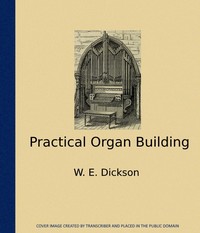
The source record for Practical Organ Building — Inside the Classic measures this digital text at 46,469 words, 3 hr 23 min estimated reading time, and 16 detected text sections.
The text analysis averages about 27.2 words per sentence, while the detected sections provide another way to judge how the source is divided.
Project Gutenberg metadata also associates the work with “Organ (Musical instrument) -- Construction,” connecting these edition facts with the source record’s subject description.
Explore this collection
These alternatives are selected using recorded categories and estimated reading time.
About 210 minutes
Theory Instruction
48,183 recorded words. 7 minutes difference from this book's estimate.
View Gutenberg source #19499About 233 minutes
Theory Instruction
53,570 recorded words. 30 minutes difference from this book's estimate.
View Gutenberg source #58458About 168 minutes
Theory Instruction
38,475 recorded words. 35 minutes difference from this book's estimate.
View Gutenberg source #19354Search stored excerpts and compare books → Choose by your preferences →
Choices use stored catalog measurements. Estimates vary with reading speed. A shared category is a catalog label, not a claim that two books have the same argument or literary quality.
Search reads excerpt text stored with this catalog and links to its associated Gutenberg record. The connection is stored in the site database; this tool does not recheck that every excerpt is word-for-word identical to that external record. Excerpt search does not cover every chapter and does not verify historical publication dates.
Catalog snapshot checked: 2026-09-25. Coverage: 90 public books, 90 available source excerpts.
Read the complete public-domain text at its original source.
Read on Project GutenbergW. E. Dickson, Precentor of Ely Cathedral, opens his 1882 manual by distinguishing it from existing organ-building literature. He notes that Hopkins and Rimbault's respected volume, while valuable to musicians, does not enter into details essential to the workman. Similarly, encyclopedia articles lack the space for full mechanical elucidation. Dickson positions his own work as a compact, practical alternative, explicitly aimed at those who dwell in workshops rather than at organists or clergy. He praises Hamel's French treatise as exhaustive but acknowledges that English readers have lacked a similarly focused guide. The preface thus establishes a clear audience: the hands-on builder seeking concise, illustrated instruction on the mechanical processes of organ construction.
Dickson devotes careful attention to defining the basic mechanical elements of organ action, each with precise dimensions and materials. A backfall is a lever of clean wood, ⅜ inch or less in thickness, turning on a wire fulcrum; backfalls are arranged side by side in notches cut into a mahogany or oak balk called a bridge. Squares may be metal or wood, with two arms at a right angle, turning on a wire axis. Stickers are slender rods of light wood, no larger than a common cedar pencil. Trackers are flat ribands of pine, about ⅜ inch wide and less than ⅛ inch thick, though now often round rods. Tapped wires—formerly brass, then tinned iron, now phosphor-bronze—are cut with a screw-thread on half their length. Buttons are round nuts of thick leather or a gutta-percha composition. Cloths are little discs of woollen cloth, mostly red, used as mufflers to prevent rattling. Rollers are light-wood shafts with two arms, turning on wire pivots, arranged on a roller-board. Dickson's terminology is exact, and his descriptions assume the reader has access to the materials and tools needed to produce these parts.
To illustrate how these components combine, Dickson presents a simple example (Fig. 32). The key is balanced on a pin-rail; at its tail, a sticker with a wire at each end connects to a backfall working in its bridge. The other end of the backfall connects to the pull-down of the pallet via a tapped wire and button. Pressing the key raises its hinder end, pushing up the back end of the backfall, which draws down the pallet. By reversing the backfalls' position, the builder can pull down pallets in a wind-chest placed under the back of the sound-board. Dickson stresses that this rudimentary layout underlies all systems of organ action. He does not assume prior knowledge; instead, he walks through each connection, noting where cloths are slipped on wires to prevent rattling. The description is procedural, almost like a recipe, and the accompanying figure (not reproduced here) is essential to following the text.
Throughout the excerpts, Dickson reveals a craftsman's attention to material properties. Backfalls are made of clean wood; stickers of light wood; trackers of pine. Tapped wires have evolved from brass to tinned iron to phosphor-bronze, reflecting practical improvements in durability and corrosion resistance. Buttons have shifted from thick leather to a gutta-percha composition. Cloths are consistently red woollen discs—a small but telling detail that suggests a standardized workshop practice. Dickson also notes that metal squares are now screwed separately in their places, whereas wooden squares were once arranged in a bridge. These observations indicate a living tradition of incremental refinement. The author does not merely list parts; he records the materials and methods current in his time, making the book a snapshot of late-19th-century English organ-building practice. For the modern reader, these specifics offer insight into the tactile, material world of the Victorian workshop.
Dickson's manual rewards a slow, diagram-in-hand reading. The excerpts show a writer who expects his reader to be building, not just reading. Pay close attention to the dimensions and materials given for each part—they are not incidental but central to the work's practical purpose. The figures, though not included here, are integral to the text; seek them out in the original edition. This is a book to be used at the bench, not merely studied.
Leafing through Dickson’s precise diagrams of trackers and rollers, I felt the quiet patience of a craftsman’s hands—each wire and square placed with intent. That same unhurried reverence for structure came back to me later, while idly turning pages of The Appreciation of Music - Vol. 1 (of 3) — Themes and Context. One builds organs, the other hears them; both simply notice how things fit together.
Save your reaction, strongest insight, and memorable passage.