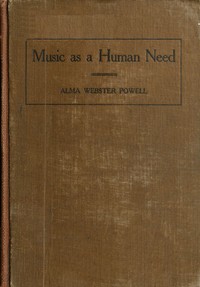
Alma Webster Powell’s 1914 doctoral thesis opens with a striking methodological premise: she will examine political and economic events only as “emotion-producing forces in social pressure,” deliberately ignoring their other values. This selective lens shapes the entire work, as Powell traces how sudden emotional reactions—rather than gradual economic shifts—drive national musical expression. The preface acknowledges that “slow changes are not sensed by whole peoples,” setting up a framework where music becomes a direct barometer of collective feeling.
A Selective Historical Method
Powell’s approach is deliberately narrow. She writes that “only such as seem to have produced a direct emotional reaction upon a people have been considered,” excluding long-term economic movements whose effects are too gradual. This choice reflects her scientific ambition: to isolate music as a measurable response to social pressure. The preface warns that events are treated not as historical facts but as “popular concepts of the moment,” acknowledging the gap between objective history and collective perception. This methodological candor is rare in early 20th-century musicology and gives the thesis a distinctive, almost sociological tone.
Schumann and the Syncopated Break
In the German section, Powell offers a pointed analysis of Robert Schumann’s syncopated accent, which she calls “the beginning of that breaking of the rhythmic effect.” She links this innovation directly to Schumann’s mental state, noting that “it was an ‘out-of-order’ effect, and came from an ‘out-of-order’ mind.” This blunt connection between biography and musical structure is characteristic of Powell’s voice. She also ties Schumann’s rhythmic experiments to later American ragtime, calling it a “forerunner.” The passage reveals her willingness to make causal claims that blend psychology, economics, and musical form.
Waltz as Rhythmic Excitation
Powell’s discussion of the waltz in 19th-century Germany illustrates her interest in music’s physiological effects. She describes the waltz as supplying “the most pronounced rhythm as a means of imparting to the body an excitation of a higher degree of rhythmic motion.” This phrasing echoes her earlier concept of music as a “rhythm-reestablisher.” She asks whether the waltz represents “the first step backward to Grecian rhythmic exercises,” suggesting a cyclical view of musical history. The passage is notable for its direct, almost clinical language about bodily response, avoiding romanticized descriptions of dance.
Powell’s thesis is best approached as a document of its time: a Progressive-era argument for state intervention in culture, grounded in a distinctive theory of emotional causation. Readers should note that the excerpts cover only the preface and part of the German chapter; the full work includes comparative studies of Italy, England, France, and the United States, as well as appendices with questionnaires and statistical tables. The author’s voice—confident, sometimes blunt, and methodologically self-aware—makes this a rewarding text for those interested in early music sociology.
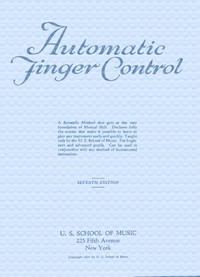
Years among these shelves have taught me that grand theses often whisper of humble practice. That 1914 plea for music’s necessity, its faith in universal education, always reminds me of a quiet companion, Automatic finger control Seventh Edition — A Closer Reading, where patient fingers learn what the soul already knows. Two books, same longing—that craft can become belonging.