About 69 minutes
Automatic finger control Seventh Edition — A Closer Reading
Theory Instruction
15,688 recorded words. 11 minutes difference from this book's estimate.
View Gutenberg source #66816
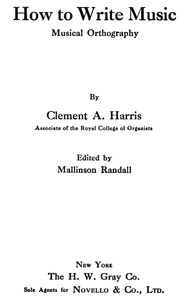
How to Write Music: Musical Orthography — Story, Setting & Ideas can be approached with a clearer sense of reading commitment from its source measurements: 13,208 words, 58 min estimated reading time, and 3 detected text sections.
The text analysis averages about 22.9 words per sentence, while the detected sections provide another way to judge how the source is divided.
Project Gutenberg metadata also associates the work with “Musical notation,” connecting these edition facts with the source record’s subject description.
Explore this collection
These alternatives are selected using recorded categories and estimated reading time.
About 69 minutes
Theory Instruction
15,688 recorded words. 11 minutes difference from this book's estimate.
View Gutenberg source #66816About 75 minutes
Theory Instruction
17,140 recorded words. 17 minutes difference from this book's estimate.
View Gutenberg source #21653About 130 minutes
Theory Instruction
29,681 recorded words. 72 minutes difference from this book's estimate.
View Gutenberg source #69337Search stored excerpts and compare books → Choose by your preferences →
Choices use stored catalog measurements. Estimates vary with reading speed. A shared category is a catalog label, not a claim that two books have the same argument or literary quality.
Search reads excerpt text stored with this catalog and links to its associated Gutenberg record. The connection is stored in the site database; this tool does not recheck that every excerpt is word-for-word identical to that external record. Excerpt search does not cover every chapter and does not verify historical publication dates.
Catalog snapshot checked: 2026-09-25. Coverage: 90 public books, 90 available source excerpts.
Read the complete public-domain text at its original source.
Read on Project GutenbergClement A. Harris opens How to Write Music: Musical Orthography with a blunt diagnosis: many competent performers cannot write a measure of music without betraying their ignorance. He distinguishes between perceptual recognition and conceptual recollection, arguing that notation must be taught concurrently with reading. This practical manual, first published in 1917, addresses that gap with numbered paragraphs and frequent historical asides.
Harris's language is direct and occasionally wry. He notes that musicians who play or sing a note at sight will, when asked to write it, “first falter over and then bungle.” The contrast between polished examination papers and “puerility” in handwriting is, he says, “ridiculous.” Such phrasing reveals an author impatient with pretension. He grounds his argument in psychology—conceptual action is a higher function than perceptual—but never lets theory overshadow the practical aim. The tone is that of a seasoned teacher who has seen the same mistakes repeated.
Harris frequently cites historical turning points to justify modern practice. He traces the shift from lozenge-shaped notes to round notes, crediting Playford's Whole Booke of Psalms (circa 1675) as an early printed example. The replacement of separate hooks with connecting horizontal lines is dated precisely to the Restoration, with Playford again named. Harris even notes that Marcello's Psalms, published in Venice as late as 1724–27, still used separate hooks, while a 1757 edition in his possession shows united hooks—a detail he attributes to venue rather than date. These references ground his prescriptions in documented evolution.
The manual's core is a set of firm rules. Stems must be placed at the right side of the note-head when turned up, at the left when turned down—though Harris admits the rule is “observed less in the case of half notes than of shorter notes.” Hooks, with one exception, go on the right side of the stem. The exception occurs when longer and shorter notes share a group: hooks not common to the whole group must lie within the group, or within the beat if the group spans multiple beats. Harris illustrates with figures (e.g., Fig. 20) and warns that in compound time, four eighth notes must not share a hook but be grouped as three and one, one and three, or two and two according to beat position.
Harris insists that hooks follow rhythm so closely that a phrase crossing the measure may have its hook cross the bar line, uniting notes in different measures. He also allows notes separated by a rest to share a hook. This attention to rhythmic integrity shows his concern for clarity over mechanical convenience. He notes that slanted hooks may follow the direction of ascending or descending note groups, though he personally prefers straight hooks. These details reveal a writer who expects the copyist to understand the music, not merely reproduce symbols.
Harris's manual rewards readers who attend to his historical references and precise terminology. The numbered paragraphs and frequent cross-references make it a reference work, but the author's voice—sometimes wry, always exact—gives it character. Readers should note that the excerpts cover only the first half of the book; later sections on vocal music, accidentals, and proofreading may extend or qualify the rules presented here.
There’s something comforting in Harris’s insistence on getting the small things right—stems, hooks, the quiet architecture of a phrase—as if notation itself were a kind of memory. It made me think of Amy Fay’s letters from Germany, that same patient devotion to craft, half a world away. Music-Study in Germany, from the Home Correspondence of Amy Fay — Context and Discussion holds that same unhurried intimacy, like hearing someone practice scales in the next room.
Your answers remain private and are stored only in this browser.