About 351 minutes
Musical Myths and Facts, Volume 2 (of 2) — Themes and Context
Music History
80,702 recorded words. 13 minutes difference from this book's estimate.
View Gutenberg source #40384
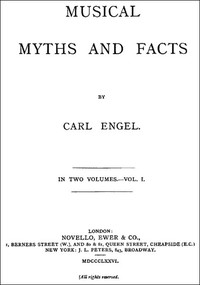
Before opening Musical Myths and Facts, Volume 1 (of 2) — Background and Themes, the edition data offers a quick orientation: 77,608 words, 5 hr 38 min estimated reading time, and 11 detected text sections.
The text analysis averages about 21.4 words per sentence, while the detected sections provide another way to judge how the source is divided.
Project Gutenberg metadata also associates the work with “Music -- History and criticism,” connecting these edition facts with the source record’s subject description.
Explore this collection
These alternatives are selected using recorded categories and estimated reading time.
About 351 minutes
Music History
80,702 recorded words. 13 minutes difference from this book's estimate.
View Gutenberg source #40384About 316 minutes
Music History
72,463 recorded words. 22 minutes difference from this book's estimate.
View Gutenberg source #59884About 310 minutes
Music History
71,160 recorded words. 28 minutes difference from this book's estimate.
View Gutenberg source #29634Search stored excerpts and compare books → Choose by your preferences →
Choices use stored catalog measurements. Estimates vary with reading speed. A shared category is a catalog label, not a claim that two books have the same argument or literary quality.
Search reads excerpt text stored with this catalog and links to its associated Gutenberg record. The connection is stored in the site database; this tool does not recheck that every excerpt is word-for-word identical to that external record. Excerpt search does not cover every chapter and does not verify historical publication dates.
Catalog snapshot checked: 2026-09-25. Coverage: 90 public books, 90 available source excerpts.
Read the complete public-domain text at its original source.
Read on Project GutenbergCarl Engel opens his preface with a deliberate choice: instead of an idealized portrait of Beethoven, he includes a rough sketch of the composer rambling through fields near Vienna. This image, he explains, signals the book's central aim—to set forth the truth rather than flattering fictions. The essays that follow are not a continuous history but a series of investigations into specific musical myths, ranging from the origins of tunes to the relationships between composers. Engel's method is forensic: he compares scores, cites obscure sources, and corrects his own errors in the preface, as when he notes that 'Sovter Liedekens' should be translated 'Psalter Little Songs' rather than as he first rendered it.
Engel devotes considerable attention to musical echoes between composers, treating plagiarism not as scandal but as a revealing historical puzzle. He examines Gluck's ballet Don Juan (1761) and argues that it contains 'the germs of several beautiful phrases' later found in Mozart's Don Giovanni. The programme of Gluck's work, he notes, is 'nearly identical' to Mozart's scenarium. Engel then traces Mozart's possible borrowings from Georg Benda's duodrama Ariadne of Naxos, pointing out that Mozart carried its score constantly in his youth. A passage from Benda's work, Engel shows, closely resembles the Queen of Night's great air in Die Zauberflöte. He also compares Mozart's overture to the same opera with a theme from Clementi's Sonata, played in Mozart's presence in 1781, and notes a resemblance to Johann Heinrich Rolle's oratorio Lazarus from 1779. Engel is careful to allow for coincidence: 'the curious resemblance may be entirely owing to the form of the fugue.'
Engel investigates the first chorus of Mozart's Requiem, arguing it was 'evidently suggested by' Handel's Funeral Anthem for Queen Caroline. But he pushes further, identifying a common source: an old German dirge from the sixteenth century beginning 'Wenn mein Stündlein vorhanden ist.' Both Handel and Mozart, Engel suggests, may have drawn independently from this traditional melody. He then prints the musical notation for the dirge and for the Kyrie Eleison from the Requiem, inviting readers to compare them directly. This method—laying scores side by side—is typical of Engel's approach. He does not claim certainty; instead, he presents evidence and lets the reader judge. The discussion exemplifies how Engel uses musical examples to challenge assumptions about originality and influence in classical music.
Engel's preface includes a remarkable section where he corrects his own statements. He acknowledges that the comprehensive Encyclopædia of Music by J. W. Moore (Boston, 1854) was 'too superficial a compilation to be of essential use' and admits he should not have omitted it. He also notes that Dr. Stainer's Dictionary of Musical Terms was published too late for inclusion. A poem on page 175, ascribed to Shakespeare, he reports, is now claimed for Richard Barnfield. And the translation error in 'Sovter Liedekens' is openly corrected. These self-corrections reveal Engel's commitment to accuracy and his awareness of the provisional nature of scholarship. They also give the reader a sense of the book as a living document, one where the author is still refining his arguments even as the pages go to press.
Engel's volume is best approached not as a systematic history but as a collection of discrete investigations, each with its own musical examples and documentary evidence. Readers may wish to follow the cross-references between volumes and to listen to the midi files included in the digital edition. The essays reward those who read with score in hand, checking Engel's claims against the music itself. His willingness to correct himself and to admit uncertainty makes him a trustworthy guide through the thickets of musical legend.
There’s something tender about how Engel untangles the myths we’ve long told ourselves about old music—how he treats received wisdom like a worn record, gently setting the needle back. That same quieting of memory lingers in Musical Memories — A Closer Reading, where the past isn’t corrected so much as revisited, like a familiar room seen in softer light.
Answer a few questions and save a private reflection on this device.