About 310 minutes
Annals of Music in America: A Chronological Record of Significant Musical Events — Text and Context
Music History
71,160 recorded words. 6 minutes difference from this book's estimate.
View Gutenberg source #29634
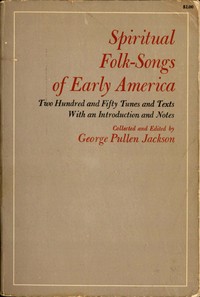
Spiritual Folk-Songs of Early America Two Hundred and Fifty Tunes and Texts, with an Introduction and Notes — Text and Context can be approached with a clearer sense of reading commitment from its source measurements: 72,463 words, 5 hr 16 min estimated reading time, and 17 detected text sections.
The text analysis averages about 18.6 words per sentence, while the detected sections provide another way to judge how the source is divided.
Project Gutenberg metadata also associates the work with “Folk songs, English -- United States,” connecting these edition facts with the source record’s subject description.
Explore this collection
These alternatives are selected using recorded categories and estimated reading time.
About 310 minutes
Music History
71,160 recorded words. 6 minutes difference from this book's estimate.
View Gutenberg source #29634About 298 minutes
Music History
68,486 recorded words. 18 minutes difference from this book's estimate.
View Gutenberg source #69378About 338 minutes
Music History
77,608 recorded words. 22 minutes difference from this book's estimate.
View Gutenberg source #40383Search stored excerpts and compare books → Choose by your preferences →
Choices use stored catalog measurements. Estimates vary with reading speed. A shared category is a catalog label, not a claim that two books have the same argument or literary quality.
Search reads excerpt text stored with this catalog and links to its associated Gutenberg record. The connection is stored in the site database; this tool does not recheck that every excerpt is word-for-word identical to that external record. Excerpt search does not cover every chapter and does not verify historical publication dates.
Catalog snapshot checked: 2026-09-25. Coverage: 90 public books, 90 available source excerpts.
Read the complete public-domain text at its original source.
Read on Project GutenbergThe volume begins not with a song but with a photograph: a group of singing leaders in Winston County, Alabama, gathered at Helicon in 1927. This image, paired with Jackson’s preface tracing the custom of singing religious songs to folk-tunes back to seventh-century England, immediately establishes the collection’s dual focus—on the living tradition of Southern rural singers and on the deep historical roots of their practice. The preface cites William of Malmsbury and King Alfred to argue that the practice has continued “unbroken for at least thirteen centuries,” a claim that frames the 250 tunes and texts as evidence of a persistent, evolving musical culture.
Jackson’s preface is not a simple introduction; it is a compact historical thesis. He asserts that the custom of singing religious words to folk tunes “showed a lack of respect for religion” only to immediately counter that it “emphasized the respect and love of the folk for their traditional music.” The anecdote of St. Aldhelm—who posed as a gleeman to draw crowds and then inserted scripture into popular songs—serves as evidence that this practice was deliberate and ancient. Jackson notes that one of Aldhelm’s songs was still sung “almost five hundred years later,” a claim that links the medieval past directly to the American South. Readers should note how this preface sets up the collection not as a mere anthology but as a demonstration of cultural continuity.
Each song entry includes a tune name, modal classification, and a dense apparatus of cross-references. For example, the tune “Clamanda” is labeled “Heptatonic aeolian, mode 2 A + b (I II 3 IV V 6 7)” and linked to multiple sources: CHI 12, KNH 109, UH 63, and others. Jackson also traces secular relatives, noting that the tune of “Clamanda” is “almost identical” to the English folk song “Just as the Tide Was a-Flowing.” Similarly, “Mecklinburg” is connected to “St. Patrick was a Gentleman” and “I’m Seventeen Come Sunday.” These annotations reveal Jackson’s method: he treats each tune as a node in a transatlantic network, and readers can follow these references to explore the movement of melodies across time and geography.
The lyrics in the excerpts are characterized by direct address and vivid, often martial imagery. “Clamanda” opens with “Say now, ye lovely social band, / Who walk the way to Canaan’s land” and later warns against “pleasure’s siren song.” “Mecklinburg” shifts to ecstatic personal testimony: “Bright scenes of glory strike my sense, / And all my passions capture.” The repeated use of “O” and “Say” creates a sense of oral performance, as if the singer is exhorting a congregation. Jackson’s notes often attribute texts to earlier sources—for instance, “Clamanda” is linked to a Christmas carol in JFSS—so readers can compare versions and see how lyrics were adapted.
Although the full index is not included in the excerpts, the annotations consistently refer to other collections by acronym: WS, OSH, SKH, SOH, and many more. Jackson assumes readers have access to these works or are willing to follow the trail. For instance, the note for “Salvation (B)” points to “White Spirituals, p. 167, for a secular relative of the tune.” This cross-referencing system turns the book into a research tool: each entry is a starting point for tracing a tune’s history. First-time readers may find the abbreviations dense, but they reward patient exploration. The collection is best approached not as a simple songbook but as a scholarly apparatus that invites investigation.
Jackson’s collection rewards a nonlinear reading: start with a song that catches your eye, then follow its cross-references to discover related tunes, secular variants, and historical notes. The preface provides the argument, the annotations the evidence, and the texts the living voice. By moving between these layers, readers can experience both the scholarly framework and the folk tradition it seeks to preserve.
Opening Jackson’s book, I recalled an old aunt humming “Poor Wayfaring Stranger” while shelling peas, the tune older than any of us. That same hushed recognition came from Charles Dickens and Music — Background and Themes, where ballads seemed to live inside characters, not merely around them. Both books remind me that songs carry what we forget to say aloud.
Build a private reading journal entry for this title.