About 338 minutes
Musical Myths and Facts, Volume 1 (of 2) — Background and Themes
Music History
77,608 recorded words. 13 minutes difference from this book's estimate.
View Gutenberg source #40383
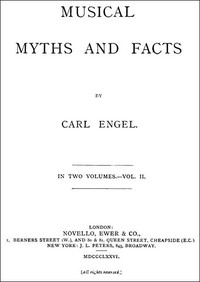
For Musical Myths and Facts, Volume 2 (of 2) — Themes and Context, the stored edition analysis reports 80,702 words, 5 hr 51 min estimated reading time, and 9 detected text sections.
The text analysis averages about 18.2 words per sentence, while the detected sections provide another way to judge how the source is divided.
Project Gutenberg metadata also associates the work with “Music -- History and criticism,” connecting these edition facts with the source record’s subject description.
Explore this collection
These alternatives are selected using recorded categories and estimated reading time.
About 338 minutes
Music History
77,608 recorded words. 13 minutes difference from this book's estimate.
View Gutenberg source #40383About 366 minutes
Music History
84,160 recorded words. 15 minutes difference from this book's estimate.
View Gutenberg source #42097About 375 minutes
Music History
86,174 recorded words. 24 minutes difference from this book's estimate.
View Gutenberg source #73991Search stored excerpts and compare books → Choose by your preferences →
Choices use stored catalog measurements. Estimates vary with reading speed. A shared category is a catalog label, not a claim that two books have the same argument or literary quality.
Search reads excerpt text stored with this catalog and links to its associated Gutenberg record. The connection is stored in the site database; this tool does not recheck that every excerpt is word-for-word identical to that external record. Excerpt search does not cover every chapter and does not verify historical publication dates.
Catalog snapshot checked: 2026-09-25. Coverage: 90 public books, 90 available source excerpts.
Read the complete public-domain text at its original source.
Read on Project GutenbergCarl Engel's second volume of Musical Myths and Facts opens with a biographical sketch of Handel's youth, noting the scant records and Handel's initial law studies—a detail that underscores the uncertain path to a musical career. The volume then shifts abruptly into a collection of folk tales and historical curiosities, where music becomes a force that compels dance, disrupts order, and even causes death. Engel's method is to present these narratives with minimal commentary, allowing the reader to observe recurring motifs: the magical instrument, the unwitting musician, and the boundary between the mundane and the supernatural.
The tale of Bakâla, a shepherd who acquires an old bagpipe from a cloud-dwelling spirit, illustrates music's capacity to override human will. Engel describes how the bagpipe's sound makes everyone dance—sheep, a village Pope, and eventually the Pope's wife, who dances herself to death. The narrative is structured around escalating consequences: first the flock, then the hidden master, then the skeptical wife. Engel includes precise details, such as the Pope binding stones to his feet for stability, which ground the fantastical events in physical reality. The wife's defiance—'Fudge! I to be frightened by a bagpipe?'—is met with a fatal outcome, suggesting that music in these stories operates as an amoral, irresistible force.
Engel's version of the two hunchbacks, sourced from Rhenish Prussia, begins with a hump-backed musician returning from a wedding at midnight. The clock's boom and a strange whirring in the air signal a supernatural encounter. The narrative relies on precise temporal and spatial markers—St. Matthew's day, 1549, the Minster in Aachen—to lend credibility to the fantastic. Engel notes that variants of this tale appear in Ireland, Germany, Italy, and Spain, pointing to a widespread folk motif without claiming a single origin. The story's structure hinges on the contrast between the musician's drowsy state and the sudden intrusion of the uncanny, a pattern Engel repeats across multiple entries.
The volume's table of contents reveals a deliberate juxtaposition of topics: 'Diabolic Music' sits alongside 'The Rat-Catcher of Hameln' and 'Royal Musicians.' Engel moves from the supernatural to the historical without transitional commentary, leaving the reader to infer connections. In 'Mattheson on Handel,' he focuses on the scarcity of biographical records, a theme that recurs in 'Composers and Practical Men' and 'Music and Medicine.' This structural choice emphasizes the fragmentary nature of musical history, where myth and fact are often intertwined. Engel's own voice is restrained, allowing the excerpts to speak for themselves, though his selection of tales—such as the bagpipe's lethal dance—betrays a fascination with music's darker, uncontrollable aspects.
Engel's narratives frequently shift between domestic interiors and open landscapes, creating a sense of spatial instability. Bakâla moves from a mountain cloud to a valley field to the Pope's house; the two hunchbacks travel from a village wedding to the Minster at midnight. These transitions are often marked by specific times—'late at night,' 'on St. Matthew's day'—that heighten the liminal quality of the events. Engel also includes musical notation and links to MIDI files, a feature that bridges the textual and auditory. The reader is thus invited to experience the stories not just as narratives but as performances, where the boundary between reading and hearing is deliberately blurred.
Engel's volume resists easy categorization, blending folklore, biography, and musicology into a single, idiosyncratic work. Readers should approach it as a collection of fragments rather than a unified argument, paying attention to the recurring images of dance, compulsion, and the supernatural. The absence of a concluding synthesis is itself meaningful: Engel leaves the myths and facts to stand side by side, inviting the reader to draw their own connections.
Reading about the Bakâla’s pipes, I remembered my grandmother humming old airs in the kitchen, each tune a small superstition. That same weight of story behind the notes came back reading Shakespeare and music — Story, Setting & Ideas. Both books feel like someone quietly showing me why a melody clings to a place, not explaining it, just letting the mystery breathe.
Save your reaction, strongest insight, and memorable passage.