
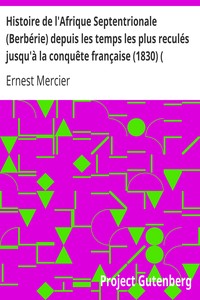
Histoire de l'Afrique Septentrionale (Berbérie) depuis les temps les plus…
Read "Histoire de l'Afrique Septentrionale (Berbérie) depuis les temps les plus…" Online
This book is available in the public domain. Start reading the digital edition below.
Book Preview
A short preview of the book’s content is shown below to give you an idea of its style and themes.
If you think North African history begins with Carthage or Rome, Ernest Mercier's work is here to change your mind. This book is his attempt to write the history of the Berber people—the indigenous communities of North Africa—from the earliest times up to the 19th century. He wasn't just retelling old tales; he was building a story from fragments, using sources many European historians of his time ignored.
The Story
There isn't a traditional plot with characters, but there is a powerful narrative drive. Mercier guides us through the rise and fall of Berber kingdoms, their complex relationships with Phoenician traders, the Roman Empire, and later Arab dynasties. He shows how these communities weren't just passive subjects of conquest but active players who shaped their own destiny, formed powerful states like Numidia, and maintained their cultural identity through centuries of change. The "story" is their enduring presence against a backdrop of constant external pressure.
Why You Should Read It
This book flips the script. Instead of seeing North Africa as just a province of someone else's empire, you see it as a homeland. Mercier's passion is clear—he wants to give the Berbers their historical voice back. Reading it, you get a sense of a deep, resilient culture that adapted and persisted. It challenges the simplistic "invader vs. invaded" narrative and introduces you to fascinating figures like the warrior queen Kahina, who led resistance against the Arab expansion, or the intricacies of the medieval Berber dynasties. It makes the map look completely different.
Final Verdict
This is for the curious reader who feels that mainstream history has blind spots. It's perfect for anyone interested in North Africa, indigenous histories, or for readers who enjoy seeing a scholar piece together a puzzle from lost pieces. Be warned, it's an older academic work, so the style can be dense in places. But push through, and you'll find a perspective that is still refreshing and vital today. Think of it less as a light novel and more as an invitation to explore a forgotten corridor in the vast mansion of human history.
This content is free to share and distribute. Knowledge should be free and accessible.
William Martinez
1 year agoGreat read!




Susan Harris
2 years agoWithout a doubt, the content flows smoothly from one chapter to the next. Definitely a 5-star read.