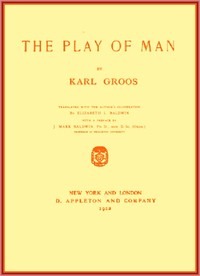
The Play of Man by Karl Groos

(16 User reviews)   7073
By Ronald Gonzalez Posted on Dec 25, 2025
In Category - Economics
Groos, Karl, 1861-1946 Groos, Karl, 1861-1946
English
Ever wonder why kids play tag, or why adults get lost in games? This isn't just about fun and games—it’s a deep look at why play is essential for human survival and growth. Karl Groos, writing over a century ago, argues that play isn't a waste of time. Instead, it’s how we practice skills we need for life, from physical coordination to social rules. If you've ever watched a child pretend or been caught up in a sport, this book will make you see those moments in a whole new light. It’s a surprisingly fresh take on something we all do but rarely stop to think about.
Share

Read "The Play of Man by Karl Groos" Online

This book is available in the public domain. Start reading the digital edition below.

START READING FULL BOOK
Instant Access    Mobile Friendly

Book Preview

A short preview of the book’s content is shown below to give you an idea of its style and themes.

(Sprödigkeit), “Modesty” (Bescheidenheit), “Shame” (Scham), etc. Biologists will note the adoption of “Rudiment” for Anlage in its biological sense. Intrinsically the work will be found a worthy companion to The Play of Animals, a book which has already become famous. J. MARK BALDWIN. PRINCETON UNIVERSITY, _February, 1901_. AUTHOR’S PREFACE In this work my aim is to present the anthropological aspects of the same subject treated of in my psychological investigation of animal play, published in 1896, which may be said to have been a pioneer attempt in its department. In the discussion of human play, however, I am supported by valuable philosophical works, among which I acknowledge myself especially indebted to those of Schaller, Lazarus, and Colozza. In regard to the standpoint from which I approach the general problem of play, it is hardly necessary for me to speak at length here. It is the same practice theory on which I intrenched myself in the earlier work. The difficulties in its way, arising from our as yet imperfect understanding of human impulse life, are fully allowed for in the introduction to the first section, and I am convinced that the results attained by its adoption will, on the whole, justify the method of treatment which I have chosen. Since it was my interest in æsthetics which first induced me to turn my attention to the subject of play, it is natural that the æsthetic phase of the question should be conspicuous in this volume. Still, I wish it to be distinctly understood that my inquiry has not been conducted solely in obedience to such leadings, nor should it be judged exclusively by æsthetic criteria. I have intentionally left many questions open for more mature consideration, at some future time, when I can give to them more thought than was possible in the year’s study which I have devoted to play phenomena. KARL GROOS. BASEL, _December, 1898_. CONTENTS PAGE EDITOR’S PREFACE iii AUTHOR’S PREFACE v THE SYSTEM OF PLAY—INTRODUCTION 1 PART I _PLAYFUL EXPERIMENTATION_ I. PLAYFUL ACTIVITY OF THE SENSORY APPARATUS 7 1. Sensations of contact 7 2. Sensations of temperature 14 3. Sensations of taste 14 4. Sensations of smell 16 5. Sensations of hearing 18 (_a_) Receptive sound-play 19 (_b_) Productive sound-play 31 6. Sensations of sight 48 (_a_) Sensations of brightness 50 (_b_) The perception of colour 54 (_c_) Perception of form 60 (_d_) Perception of movement 67 II. PLAYFUL USE OF THE MOTOR APPARATUS 74 A. Playful movement of the bodily organs 75 B. Playful movement of foreign bodies 95 1. Hustling things about 95 2. Destructive (analytic) movement-play 97 3. Constructive (synthetic) movement-play 99 4. Playful exercise of endurance 101 5. Throwing plays 103 (_a_) Simple throwing 105 (_b_) Throwing with the help of a stroke or blow 107 (_c_) Rolling, spinning, shoving, and skipping foreign bodies 110 (_d_) Throwing at a mark 114 6. Catching 118 III. PLAYFUL USE OF THE HIGHER MENTAL POWERS 121 A. Experimentation with the mental powers 122 1. Memory 122 (_a_) Recognition 122 (_b_) Reflective memory 128 2. Imagination 131 (_a_) Playful illusion 131 (_b_) Playful transformation of the memory-content 135 3. Attention 144 4. Reason 152 B. Experimentation with the feelings 158 1. Physical pain 159 2. Mental suffering 160 3. Surprise 163 4. Fear 166 C. Experimentation with the will 169 PART II _THE PLAYFUL EXERCISE OF IMPULSES OF THE SECOND OR SOCIONOMIC ORDER_ I. FIGHTING PLAY 173 1. Direct physical fighting play 174 2. Direct mental contests 186 3. Physical rivalry 197 4. Mental rivalry 201 5. The destructive impulse 217 6. Teasing 220 7. Enjoyment of...

This is a limited preview. Download the book to read the full content.

Forget everything you think you know about play being just child's stuff. In The Play of Man, Karl Groos makes a bold case: play is serious business. He looks at the games of children and adults across cultures, breaking them down into categories like movement games, imitation games, and social games. Groos suggests that when a kitten pounces on a ball or a child plays house, they aren't just killing time. They are following deep instincts that prepare them for the challenges of adulthood. Play, in his view, is nature's way of making practice fun.

The Story

There isn't a plot in the traditional sense. Instead, Groos takes you on a tour of human (and animal) behavior. He starts with the idea of 'practice for life,' showing how youthful play hones physical, mental, and social skills. He examines everything from rough-and-tumble fighting games that teach control, to dramatic play that lets us experiment with different social roles. The 'story' is the unfolding argument that this seemingly frivolous activity is actually a fundamental engine of human development.

Why You Should Read It

This book changed how I see the world. Reading it, I started noticing the 'practice' in everyday play—the negotiation in a kids' game of soccer, the creativity in building a block tower. Groos connects dots between biology, psychology, and culture in a way that feels intuitive. It’s not a dry academic text; it’s filled with observations that will make you nod in recognition. It gives a satisfying explanation for why we are drawn to games, sports, and art throughout our lives.

Final Verdict

Perfect for curious parents, educators, game designers, or anyone who's ever wondered why we do what we do for fun. If you enjoy books that make you see ordinary life through a smarter lens, you'll get a lot out of this. Just be ready for its age—it was written in 1901, so some language and examples are of their time. But the core idea remains powerful and surprisingly relevant.


🟢 Public Domain Content

This work has been identified as being free of known copyright restrictions. Knowledge should be free and accessible.

Jessica Wilson
1 month ago

High quality edition, very readable.

5
5 out of 5 (16 User reviews )

Add a Review

Your Rating *
There are no comments for this eBook.
You must log in to post a comment.
Log in


Related eBooks