
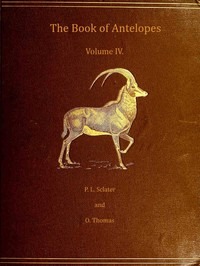
The book of antelopes, vol. 4 (of 4) by Philip Lutley Sclater and Oldfield Thomas
Read "The book of antelopes, vol. 4 (of 4) by Philip Lutley Sclater and Oldfield Thomas" Online
This book is available in the public domain. Start reading the digital edition below.
START READING FULL BOOKBook Preview
A short preview of the book’s content is shown below to give you an idea of its style and themes.
Let's be clear from the start: this isn't a novel. The Book of Antelopes, Volume 4 is the grand finale of a massive scientific project. Authors Philip Lutley Sclater and Oldfield Thomas were top zoologists of their day, and this volume represents their last word—their definitive attempt to describe, classify, and illustrate every known species of antelope in the late 1800s.
The Story
The 'plot' is the process of scientific discovery itself. The book systematically presents each antelope, from the majestic Giant Eland to tiny duikers, with detailed physical descriptions, habitat notes, and beautiful engraved plates. But the real story unfolds between the lines. You can feel the urgency. New specimens were arriving from across the British Empire, often with sparse information. The authors are constantly comparing skins and skulls, debating classifications, and correcting past errors. It's a snapshot of science in action, messy and passionate, as they try to build a complete picture from scattered, fragile evidence.
Why You Should Read It
I love this book for its sheer, obsessive dedication. It connects you directly to the minds of two men who cared deeply about the natural world. The detailed illustrations are works of art, and reading their precise notes makes you look at these animals in a new way. It’s a humbling reminder of how much effort went into foundational knowledge we now take for granted. This isn't just a list; it's a labor of love and a historical artifact.
Final Verdict
This is a niche read, but a rewarding one. It's perfect for history of science buffs, natural history enthusiasts, or anyone who appreciates beautiful old books and wants to understand the roots of wildlife conservation. Don't read it cover-to-cover; dip in, look at the pictures, read a few entries, and soak up the atmosphere of a bygone era of exploration. You'll come away with a real appreciation for these graceful animals and the people who fought to understand them.
The copyright for this book has expired, making it public property. Enjoy reading and sharing without restrictions.
Noah Walker
1 year agoTo be perfectly clear, the content flows smoothly from one chapter to the next. I would gladly recommend this title.
Kenneth Anderson
3 months agoThanks for the recommendation.






Donna Johnson
11 months agoHaving read this twice, the arguments are well-supported by credible references. A true masterpiece.