About 152 minutes
Musical Instruments [1876] — Context and Discussion
Music History
34,748 recorded words. 6 minutes difference from this book's estimate.
View Gutenberg source #54537
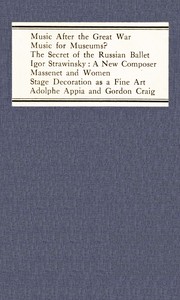
This digital edition of Music after the great war, and other studies — Inside the Classic is described by source-level measurements including 33,437 words, 2 hr 26 min estimated reading time, and 10 detected text sections.
The text analysis averages about 22.8 words per sentence, while the detected sections provide another way to judge how the source is divided.
Project Gutenberg metadata also associates the work with “Music -- 20th century -- History and criticism,” connecting these edition facts with the source record’s subject description.
Explore this collection
These alternatives are selected using recorded categories and estimated reading time.
About 152 minutes
Music History
34,748 recorded words. 6 minutes difference from this book's estimate.
View Gutenberg source #54537About 157 minutes
Music History
35,936 recorded words. 11 minutes difference from this book's estimate.
View Gutenberg source #39045About 172 minutes
Music History
39,517 recorded words. 26 minutes difference from this book's estimate.
View Gutenberg source #16595Search stored excerpts and compare books → Choose by your preferences →
Choices use stored catalog measurements. Estimates vary with reading speed. A shared category is a catalog label, not a claim that two books have the same argument or literary quality.
Search reads excerpt text stored with this catalog and links to its associated Gutenberg record. The connection is stored in the site database; this tool does not recheck that every excerpt is word-for-word identical to that external record. Excerpt search does not cover every chapter and does not verify historical publication dates.
Catalog snapshot checked: 2026-09-25. Coverage: 90 public books, 90 available source excerpts.
Read the complete public-domain text at its original source.
Read on Project GutenbergCarl Van Vechten opens his 1915 collection by recounting Leo Stein's prediction that the Great War would end cubist and futurist 'nonsense,' a remark Van Vechten immediately questions. This sets the tone for a book that scrutinizes the fault lines between established and emerging art. Rather than offering a unified thesis, the essays circle around a central tension: how audiences and critics resist new harmonic languages while claiming that contemporary composers 'could not write melody.' Van Vechten traces this complaint from Beethoven through Wagner to Strauss and Debussy, arguing that each generation's novelty lies in redefining harmony, not melody alone.
Van Vechten devotes considerable attention to Igor Stravinsky, whom he presents as a composer who deliberately abandons traditional development. He quotes critic M. D. Calvocoressi, who observed that in The Nightingale 'working-out plays no part'—the music simply expresses the text without leitmotiv or formal elaboration. Van Vechten links this to the Russian 'Five' and Moussorgsky's dictum: 'Plain truth, however unpalatable, and nothing more.' Stravinsky himself is quoted saying he aims for 'straightforward expression in its simplest form' and shuns 'vagueness and ambiguity.' Van Vechten does not endorse or reject this approach; instead, he presents it as a logical extension of earlier Russian nationalism and a direct challenge to Wagnerian and impressionist methods.
In 'The Secret of the Russian Ballet,' Van Vechten examines how the Ballets Russes achieved its impact through a fusion of dance, music, and stage design. He emphasizes the collaborative role of artists like Léon Bakst and the choreographer Michel Fokine, who broke with classical ballet conventions. The essay treats the ballet not merely as performance but as a total aesthetic experience—one that, like Stravinsky's music, resisted easy categorization. Van Vechten's analysis is grounded in specific productions and their reception, avoiding vague praise in favor of noting how the company's innovations in movement and decor challenged Parisian audiences accustomed to more static forms.
The essay on Jules Massenet takes a different tack, examining a composer whose work was widely performed yet often dismissed by critics. Van Vechten notes Massenet's ability to write for women's voices and his skill in crafting melodic lines that appealed to the public. He contrasts Massenet's approach with that of more 'serious' composers, suggesting that popularity does not preclude artistic merit. The essay draws on specific operas and their librettos, but Van Vechten stops short of claiming Massenet as a neglected genius. Instead, he uses the case to probe the criteria by which critics judge value—a recurring concern throughout the collection.
Van Vechten's essays are best read as period documents that capture a moment of aesthetic upheaval. He writes as a partisan of the new, yet his arguments are built on concrete observations about harmony, structure, and reception rather than mere advocacy. Readers interested in early twentieth-century criticism will find a writer who takes his subjects seriously without resorting to jargon or hyperbole. The book rewards those who approach it as a series of provocations rather than settled judgments.
There’s something tender about how Van Vechten caught music changing, the old forms fraying into something new. I thought of that reading The Pipes of War A Record of Achievements of Pipers of Scottish and Overseas Regiments during the War, 1914-18 — Edition Insights, where a very old sound carried men through an unimaginably new horror. Both books hold that ache—tradition leaning into the dark, hoping it still means something.
Build a private reading journal entry for this title.