About 152 minutes
Musical Instruments [1876] — Context and Discussion
Music History
34,748 recorded words. 5 minutes difference from this book's estimate.
View Gutenberg source #54537
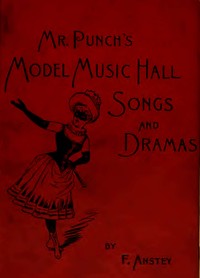
For Mr Punch's Model Music Hall Songs and Dramas Collected, Improved and Re-arranged from Punch — Themes and Context, the stored edition analysis reports 35,936 words, 2 hr 37 min estimated reading time, and 7 detected text sections.
The text analysis averages about 12.4 words per sentence, while the detected sections provide another way to judge how the source is divided.
Project Gutenberg metadata also associates the work with “Humorous songs -- England -- Texts,” connecting these edition facts with the source record’s subject description.
Explore this collection
These alternatives are selected using recorded categories and estimated reading time.
About 152 minutes
Music History
34,748 recorded words. 5 minutes difference from this book's estimate.
View Gutenberg source #54537About 146 minutes
Music History
33,437 recorded words. 11 minutes difference from this book's estimate.
View Gutenberg source #73668About 172 minutes
Music History
39,517 recorded words. 15 minutes difference from this book's estimate.
View Gutenberg source #16595Search stored excerpts and compare books → Choose by your preferences →
Choices use stored catalog measurements. Estimates vary with reading speed. A shared category is a catalog label, not a claim that two books have the same argument or literary quality.
Search reads excerpt text stored with this catalog and links to its associated Gutenberg record. The connection is stored in the site database; this tool does not recheck that every excerpt is word-for-word identical to that external record. Excerpt search does not cover every chapter and does not verify historical publication dates.
Catalog snapshot checked: 2026-09-25. Coverage: 90 public books, 90 available source excerpts.
Read the complete public-domain text at its original source.
Read on Project GutenbergF. Anstey's Mr Punch's Model Music Hall Songs and Dramas opens with a mock-serious Introduction in which a Music Hall Proprietor frets over the London County Council's tightening supervision of variety entertainments. The author imagines a future where each performance item must be pre-approved by a committee, a premise that sets the tone for the parodies to follow. The collection, originally published in Punch in 1892, gathers thirteen songs and twelve dramas that exaggerate the clichés of Victorian music hall—patriotic bombast, sentimental pathos, and melodramatic morality. Anstey's targets include the formulaic structure of these entertainments and the moral hypocrisy they often embodied.
The Introduction is not merely a preface but a satirical sketch in itself. Anstey adopts the voice of a Music Hall Proprietor who laments the “moral microscope” of the County Council, which once detected “latent indecency in the pursuit of a butterfly by a marionette.” This specific reference grounds the satire in real contemporary debates about censorship. The Proprietor’s exaggerated deference to authority—calling the councilmen “far-sighted and vigilant”—undermines their seriousness. By framing the collection as a prophetic model of what approved entertainments might look like, Anstey invites readers to view each song and drama as a specimen of absurd conformity. The Introduction thus primes the audience to read the pieces not as genuine performances but as parodic templates.
In the drama “The Fatal Pin,” Anstey pushes melodramatic logic to its breaking point. The plot hinges on a dropped pin: Emily fails to pick it up, Peter steps on it, and this leads to a breakup, Emily’s suicide, and Peter’s regret—all over a pin. The dialogue is stilted and overblown: Peter declares his wound “goes deeper than you wot of yet,” and Emily’s dying words include instructions for her rabbits and canary. The climax, where Emily stabs herself with the same pin, is followed by Peter’s cold remark, “Nay, these are histrionics, Emily.” Anstey’s parody works by taking the moralizing lesson of Victorian melodrama—that small neglects lead to ruin—and literalizing it to the point of farce. The pin becomes a symbol of triviality treated with deadly seriousness.
The song section categorizes music-hall types: Patriotic, Topical-Political, Democratic Ditty, Idyllic, Amatory Episodic, and so on. Each is a parody of a recognizable style. For instance, the “Patriotic” song likely inflates national pride to jingoistic extremes, while the “Frankly Canaille” suggests vulgarity worn as a badge. Anstey’s method is taxonomic: he reduces music-hall songs to a set of formulas, then exaggerates their defining features. The headings themselves—such as “Disinterested Passion” or “The Plaintively Pathetic”—mock the predictability of these genres. Readers familiar with Victorian music hall will recognize the targets; others can enjoy the absurdity of the sentiments expressed. The songs are presented as model examples, implying that any competent writer could churn them out by following the pattern.
The dramas include titles like “The Little Crossing-Sweeper,” “Joe, the Jam-eater,” and “Brunette and Blanchidine.” The latter is subtitled “A Melodramatic Didactic Vaudeville” and is suggested by a poem by Jane and Ann Taylor. This piece, performed by the “celebrated Sisters Stilton,” likely contrasts two sisters—one wax, one wooden—in a moral tale. Anstey’s subtitle signals his awareness of the didactic strain in children’s literature and melodrama. Other dramas, such as “Conrad; or, the Thumbsucker,” parody cautionary tales. The collection as a whole treats these forms as interchangeable: a song can become a drama, a moral can be inflated into a catastrophe. Anstey’s consistent technique is to take a trivial premise and treat it with mock-heroic gravity, exposing the artificiality of Victorian entertainment.
Reading Mr Punch's Model Music Hall Songs and Dramas as a first-time visitor to Victorian parody, it helps to keep the Introduction in mind: the pieces are not meant to be taken straight but as exaggerated models. Anstey’s humor relies on recognizing the conventions he mocks—the moralizing, the stock characters, the inflated language. The collection rewards attention to small details, like the repeated use of pins or the formulaic song titles. For those unfamiliar with music hall, the dramas are more immediately accessible, as their absurd plots speak for themselves.
There’s something oddly tender about how F. Anstey’s parodies grasp the very sentiment they mock, leaving you unsure whether to laugh or ache. That same strange warmth stayed with me afterward, much like the quiet way Memories of a Musical Life — Themes and Context lingers—less a story told than a feeling hummed, long after the room goes still.
Answer a few questions and save a private reflection on this device.