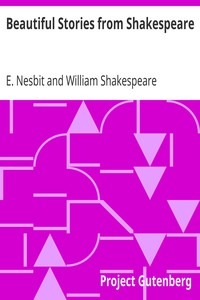
Beautiful Stories from Shakespeare by E. Nesbit and William Shakespeare

(17 User reviews)   7364
By Ronald Gonzalez Posted on Dec 25, 2025
In Category - Economics
Shakespeare, William, 1564-1616 Shakespeare, William, 1564-1616
English
Ever feel like Shakespeare is a locked door you just can't open? 'Beautiful Stories from Shakespeare' is the key. This isn't the Bard in his original, dense verse. Instead, E. Nesbit takes the most famous plays—like the magical mix-ups of 'A Midsummer Night's Dream,' the heartbreaking jealousy in 'Othello,' and the star-crossed love in 'Romeo and Juliet'—and retells them as clear, lively stories. She keeps all the drama, romance, and betrayal but makes it easy to follow. Think of it as the ultimate spoiler that actually makes you want to read the originals. It’s the perfect way to finally get what all the fuss is about.
Share

Read "Beautiful Stories from Shakespeare by E. Nesbit and William Shakespeare" Online

This book is available in the public domain. Start reading the digital edition below.

START READING FULL BOOK
Instant Access    Mobile Friendly

Book Preview

A short preview of the book’s content is shown below to give you an idea of its style and themes.

and included in the volume a Pronouncing Vocabulary of Difficult Names. To which is added a collection of Shakespearean Quotations, classified in alphabetical order, illustrative of the wisdom and genius of the world's greatest dramatist. E. T. R. A BRIEF LIFE OF SHAKESPEARE. In the register of baptisms of the parish church of Stratford-upon-Avon, a market town in Warwickshire, England, appears, under date of April 26, 1564, the entry of the baptism of William, the son of John Shakspeare. The entry is in Latin--“Gulielmus filius Johannis Shakspeare.” The date of William Shakespeare's birth has usually been taken as three days before his baptism, but there is certainly no evidence of this fact. The family name was variously spelled, the dramatist himself not always spelling it in the same way. While in the baptismal record the name is spelled “Shakspeare,” in several authentic autographs of the dramatist it reads “Shakspere,” and in the first edition of his works it is printed “Shakespeare.” Halliwell tells us, that there are not less than thirty-four ways in which the various members of the Shakespeare family wrote the name, and in the council-book of the corporation of Stratford, where it is introduced one hundred and sixty-six times during the period that the dramatist's father was a member of the municipal body, there are fourteen different spellings. The modern “Shakespeare” is not among them. Shakespeare's father, while an alderman at Stratford, appears to have been unable to write his name, but as at that time nine men out of ten were content to make their mark for a signature, the fact is not specially to his discredit. The traditions and other sources of information about the occupation of Shakespeare's father differ. He is described as a butcher, a woolstapler, and a glover, and it is not impossible that he may have been all of these simultaneously or at different times, or that if he could not properly be called any one of them, the nature of his occupation was such as to make it easy to understand how the various traditions sprang up. He was a landed proprietor and cultivator of his own land even before his marriage, and he received with his wife, who was Mary Arden, daughter of a country gentleman, the estate of Asbies, 56 acres in extent. William was the third child. The two older than he were daughters, and both probably died in infancy. After him was born three sons and a daughter. For ten or twelve years at least, after Shakespeare's birth his father continued to be in easy circumstances. In the year 1568 he was the high bailiff or chief magistrate of Stratford, and for many years afterwards he held the position of alderman as he had done for three years before. To the completion of his tenth year, therefore, it is natural to suppose that William Shakespeare would get the best education that Stratford could afford. The free school of the town was open to all boys and like all the grammar-schools of that time, was under the direction of men who, as graduates of the universities, were qualified to diffuse that sound scholarship which was once the boast of England. There is no record of Shakespeare's having been at this school, but there can be no rational doubt that he was educated there. His father could not have procured for him a better education anywhere. To those who have studied Shakespeare's works without being influenced by the old traditional theory that he had received a very narrow education, they abound with evidences that he must have been...

This is a limited preview. Download the book to read the full content.

So, what's this book actually about? It's a collection of the greatest hits. E. Nesbit takes twenty of Shakespeare's plays and turns them into straightforward prose stories. You get the full plot, the major characters, and the big emotional moments, all without having to decode Elizabethan English. It's like getting the map before you explore the territory.

Why You Should Read It

This book removes the intimidation factor. You can finally understand the clever schemes in Much Ado About Nothing or feel the tragic weight of Macbeth's choices without getting tripped up by the language. Nesbit has a real gift for capturing the heart of each story. You see the universal themes—love, power, revenge, forgiveness—shine through, clean and bright. It makes you realize these plays aren't dusty old texts; they're packed with raw human emotion and wild plots that still feel fresh.

Final Verdict

This is the perfect starter kit for anyone curious about Shakespeare but unsure where to begin. It's fantastic for students, parents reading with older kids, or book clubs that want to dip a toe into the classics. Even if you know the plays well, it's a joy to see them distilled into such clear, energetic tales. Consider this your friendly, welcoming guide to the world's greatest storyteller.


ℹ️ Public Domain Content

Legal analysis indicates this work is in the public domain. Knowledge should be free and accessible.

Sarah Flores
1 year ago

I stumbled upon this title and the flow of the text seems very fluid. This story will stay with me.

Joshua Allen
8 months ago

Clear and concise.

James Ramirez
1 year ago

Surprisingly enough, the author's voice is distinct and makes complex topics easy to digest. A true masterpiece.

Donald Gonzalez
2 months ago

Finally found time to read this!

David Sanchez
1 month ago

If you enjoy this genre, the clarity of the writing makes this accessible. I learned so much from this.
4.5
4.5 out of 5 (17 User reviews )

Add a Review

Your Rating *
There are no comments for this eBook.
You must log in to post a comment.
Log in


Related eBooks