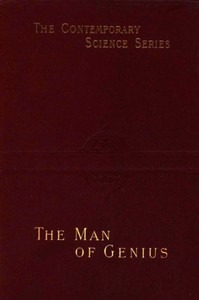
The Man of Genius by Cesare Lombroso

(8 User reviews)   6778
By Ronald Gonzalez Posted on Dec 25, 2025
In Category - Productivity
Lombroso, Cesare, 1835-1909 Lombroso, Cesare, 1835-1909
English
Ever wonder if the greatest artists, writers, and thinkers in history were actually a little bit... insane? That's the wild question at the heart of 'The Man of Genius.' Written in the 1800s, this book makes a shocking argument: genius isn't just about talent, it's a biological condition linked to madness, epilepsy, and physical 'degeneracy.' Lombroso studies the lives of famous figures, pointing out their odd habits and health issues as proof. It's a fascinating, deeply flawed, and totally controversial time capsule. Reading it today feels like uncovering a strange, forgotten theory that tried to scientifically explain the magic of creativity. It will make you rethink everything you thought you knew about what makes a genius.
Share

Read "The Man of Genius by Cesare Lombroso" Online

This book is available in the public domain. Start reading the digital edition below.

START READING FULL BOOK
Instant Access    Mobile Friendly

Book Preview

A short preview of the book’s content is shown below to give you an idea of its style and themes.

I. THE EVOLUTION OF SEX. By Prof. PATRICK GEDDES and J. A. THOMSON. With 90 Illustrations. Second Edition. “The authors have brought to the task--as indeed their names guarantee--a wealth of knowledge, a lucid and attractive method of treatment, and a rich vein of picturesque language.”--_Nature._ II. ELECTRICITY IN MODERN LIFE. By G. W. DE TUNZELMANN. With 88 Illustrations. “A clearly-written and connected sketch of what is known about electricity and magnetism, the more prominent modern applications, and the principles on which they are based.”--_Saturday Review._ III. THE ORIGIN OF THE ARYANS. By Dr. ISAAC TAYLOR. Illustrated. Second Edition. “Canon Taylor is probably the most encyclopædic all-round scholar now living. His new volume on the Origin of the Aryans is a first-rate example of the excellent account to which he can turn his exceptionally wide and varied information.... Masterly and exhaustive.”--_Pall Mall Gazette._ IV. PHYSIOGNOMY AND EXPRESSION. By P. MANTEGAZZA. Illustrated. “Brings this highly interesting subject even with the latest researches.... Professor Mantegazza is a writer full of life and spirit, and the natural attractiveness of his subject is not destroyed by his scientific handling of it.”--_Literary World_ (Boston). V. EVOLUTION AND DISEASE. By J. B. SUTTON, F.R.C.S. With 135 Illustrations. “The book is as interesting as a novel, without sacrifice of accuracy or system, and is calculated to give an appreciation of the fundamentals of pathology to the lay reader, while forming a useful collection of illustrations of disease for medical reference.”--_Journal of Mental Science._ VI. THE VILLAGE COMMUNITY. By G. L. GOMME. Illustrated. “The fruit of some years of investigation on a subject which has of late attracted much attention, and is of much importance, inasmuch as it lies at the basis of our society.”--_Antiquary._ VII. THE CRIMINAL. By HAVELOCK ELLIS. Illustrated. “An ably written, an instructive, and a most entertaining book.”--_Law Quarterly Review._ “The sociologist, the philosopher, the philanthropist, the novelist--all, indeed, for whom the study of human nature has any attraction--will find Mr. Ellis full of interest and suggestiveness.”--_Academy._ VIII. SANITY AND INSANITY. By Dr. CHARLES MERCIER. Illustrated. “He has laid down the institutes of insanity.”--_Mind._ “Taken as a whole, it is the brightest book on the physical side of mental science published in our time.”--_Pall Mall Gazette._ IX. HYPNOTISM. By Dr. ALBERT MOLL. Second Edition. “Marks a step of some importance in the study of some difficult physiological and psychological problems which have not yet received much attention in the scientific world of England.”--_Nature._ X. MANUAL TRAINING. By Dr. C. M. WOODWARD, Director of the Manual Training School, St. Louis. Illustrated. “There is no greater authority on the subject than Professor Woodward.”--_Manchester Guardian._ XI. THE SCIENCE OF FAIRY TALES. By E. SIDNEY HARTLAND. “Mr. Hartland’s book will win the sympathy of all earnest students, both by the knowledge it displays, and by a thorough love and appreciation of his subject, which is evident throughout.”--_Spectator._ XII. PRIMITIVE FOLK. By ELIE RECLUS. “An attractive and useful introduction to the study of some aspects of ethnography.”--_Nature._ “For an introduction to the study of the questions of property, marriage, government, religion,--in a word, to the evolution of society,--this little volume will be found most convenient.”--_Scottish Leader._ XIII. THE EVOLUTION OF MARRIAGE. By Professor LETOURNEAU. “Among the distinguished French students of sociology, Professor Letourneau has long stood in the first rank. He approaches the great study of man free from bias and shy of generalisations. To collect, scrutinise, and appraise facts is his chief business. In the volume before us he shows these qualities in an admirable degree.... At the close of his attractive pages he ventures to forecast the...

This is a limited preview. Download the book to read the full content.

Forget everything you think you know about brilliant minds. In 'The Man of Genius,' Cesare Lombroso, an Italian doctor in the late 1800s, presents a theory that would have made headlines if Twitter existed back then. He wasn't interested in praising genius; he was trying to diagnose it.

The Story

This isn't a novel with a plot, but a scientific argument built on a mountain of examples. Lombroso collects stories about famous geniuses—from composers like Beethoven to writers like Rousseau. He catalogs their struggles: migraines, nervous tics, depression, epilepsy, and even physical features he considered 'abnormal.' His conclusion? Genius is a form of hereditary insanity, a kind of mental illness that also brings extraordinary talent. He saw the great artist not as a hero, but as a medical case study.

Why You Should Read It

Reading this book is a trip. It's equal parts fascinating and uncomfortable. You get this raw, unfiltered look at how people in the past tried to make sense of human complexity with the limited (and often prejudiced) science they had. It forces you to ask big questions about the line between creativity and madness that we still debate today. While his methods are wildly unscientific by modern standards, the sheer audacity of his project is compelling. It's less of a textbook and more of a historical artifact that shows how ideas about talent and identity have changed.

Final Verdict

This book is perfect for readers who love intellectual history, true crime fans interested in the origins of criminal profiling (Lombroso pioneered that, too!), or anyone who enjoys a provocative, debate-sparking read. Don't pick it up for solid facts; pick it up to understand a pivotal, flawed moment in the history of science and to have your own ideas about genius thoroughly challenged. Just be prepared to disagree with the author on almost every page.


⚖️ Usage Rights

No rights are reserved for this publication. Distribute this work to help spread literacy.

Donna Davis
1 year ago

This book was worth my time since the content flows smoothly from one chapter to the next. Don't hesitate to start reading.

Paul Sanchez
8 months ago

Without a doubt, the flow of the text seems very fluid. I would gladly recommend this title.

Andrew Johnson
1 year ago

Wow.

5
5 out of 5 (8 User reviews )

Add a Review

Your Rating *
There are no comments for this eBook.
You must log in to post a comment.
Log in


Related eBooks