About 505 minutes
Richard Wagner, Composer of Operas — Themes and Context
Music History
116,003 recorded words. 112 minutes difference from this book's estimate.
View Gutenberg source #16431
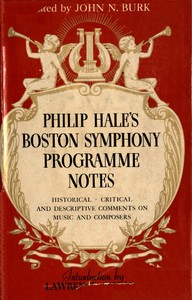
This digital edition of Philip Hale's Boston Symphony Programme Notes — Story, Setting & Ideas is described by source-level measurements including 141,771 words, 10 hr 17 min estimated reading time, and 20 detected text sections.
The text analysis averages about 18.5 words per sentence, while the detected sections provide another way to judge how the source is divided.
Project Gutenberg metadata also associates the work with “Music appreciation,” connecting these edition facts with the source record’s subject description.
Explore this collection
These alternatives are selected using recorded categories and estimated reading time.
About 505 minutes
Music History
116,003 recorded words. 112 minutes difference from this book's estimate.
View Gutenberg source #16431About 502 minutes
Music History
115,279 recorded words. 115 minutes difference from this book's estimate.
View Gutenberg source #30560About 493 minutes
Music History
113,203 recorded words. 124 minutes difference from this book's estimate.
View Gutenberg source #58871Search stored excerpts and compare books → Choose by your preferences →
Choices use stored catalog measurements. Estimates vary with reading speed. A shared category is a catalog label, not a claim that two books have the same argument or literary quality.
Search reads excerpt text stored with this catalog and links to its associated Gutenberg record. The connection is stored in the site database; this tool does not recheck that every excerpt is word-for-word identical to that external record. Excerpt search does not cover every chapter and does not verify historical publication dates.
Catalog snapshot checked: 2026-09-25. Coverage: 90 public books, 90 available source excerpts.
Read the complete public-domain text at its original source.
Read on Project GutenbergPhilip Hale’s programme notes for the Boston Symphony Orchestra were written for audiences approaching unfamiliar works with open minds. As editor John N. Burk explains, Hale “judiciously withheld his individual opinion” in these notes, reserving his frank assessments for newspaper reviews of the same concerts. This volume brings the two together, placing a critical paragraph before each programme note to show the transition from personal reaction to historical exposition. The result is a layered record of how one discerning listener engaged with new music—often delivering judgments that later proved remarkably sound.
Burk’s editorial method is explicit: he draws from the programme books Hale wrote for thirty-two years, then supplements them with “pertinent critical paragraphs” from Hale’s newspaper columns. A typographical ornament marks the shift from criticism to descriptive note. This structure lets readers compare Hale’s private enthusiasm or skepticism with the measured tone he adopted for concertgoers. For example, his note on Mendelssohn’s A Midsummer Night’s Dream overture is a dry chronicle of performances, keys, and themes; the accompanying review, if included, would presumably show a different register. The editor notes that Hale “never spoke as a major prophet, but as one who might be discussing a favorite subject over a demi-tasse.”
Hale’s note on the Midsummer Night’s Dream overture demonstrates his method. He traces the work’s premiere at Stettin in 1827, the lost score in a hackney coach, and the dedication to the Crown Prince of Prussia. Then he describes the music with technical specificity: the opening “allegro di molto, E major, 2-2, with four prolonged chords in the wood-wind,” followed by a “pianissimo chord of E minor in violins and violas.” He identifies the “fairy music,” the Bergomask dance, and even an allusion to Bottom’s bray. A curious detail—the descending cello scale suggested by “the buzzing of a big fly in the Schoenhauser Garten”—shows Hale’s willingness to include anecdotal color within a factual framework.
The editor’s introduction reveals a striking self-awareness in Hale. In 1912 he predicted that a student in 1945 would “be amused by opinions expressed by us all, of works first heard in 1912.” Burk, writing in 1935, finds cause for wonder at Hale’s “quick perception of essential values upon first hearing.” The volume thus becomes a test case for critical longevity: which judgments hold, which falter? Hale’s contemporaries often “wrote laughably of a then new tone poem of Richard Strauss or pastel of Claude Debussy,” while Hale delivered “a sane and still quotable judgment.” The reader is invited to observe how Hale’s prose shifts pace—from the unhurried historical narrative of the programme note to the sharper, more personal tone of the newspaper paragraph.
Because the excerpts here are limited to the editor’s note and one programme note on Mendelssohn, the full range of Hale’s voice—from the brisk critical aside to the leisurely historical essay—can only be glimpsed. Readers interested in how a working critic balanced documentation and opinion will find this collection a rich case study. The typographical ornament between review and note becomes a small but telling marker of a divided professional self.
There’s something tender about reading those old programme notes—Hale’s patient hand guiding us through thirty-two seasons, balancing fact with his own quiet judgments. It reminds me of sitting with The Perfect Wagnerite: A Commentary on the Niblung's Ring — Background and Themes, where the same careful voice turns myth into something almost conversational. Both feel like letters from a thoughtful friend, not lectures.
Build a private reading journal entry for this title.