About 175 minutes
Among the Great Masters of Music Scenes in the Lives of Famous Musicians — Text and Context
Music History
40,129 recorded words. 1 minutes difference from this book's estimate.
View Gutenberg source #21056
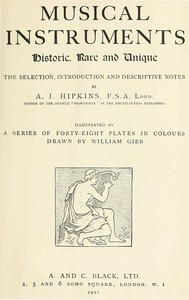
Before opening Musical Instruments, Historic, Rare and Unique — Edition Insights, the edition data offers a quick orientation: 39,826 words, 2 hr 54 min estimated reading time, and 7 detected text sections.
The text analysis averages about 19.1 words per sentence, while the detected sections provide another way to judge how the source is divided.
Project Gutenberg metadata also associates the work with “Musical instruments,” connecting these edition facts with the source record’s subject description.
Explore this collection
These alternatives are selected using recorded categories and estimated reading time.
About 175 minutes
Music History
40,129 recorded words. 1 minutes difference from this book's estimate.
View Gutenberg source #21056About 172 minutes
Music History
39,517 recorded words. 2 minutes difference from this book's estimate.
View Gutenberg source #16595About 186 minutes
Music History
42,617 recorded words. 12 minutes difference from this book's estimate.
View Gutenberg source #20139Search stored excerpts and compare books → Choose by your preferences →
Choices use stored catalog measurements. Estimates vary with reading speed. A shared category is a catalog label, not a claim that two books have the same argument or literary quality.
Search reads excerpt text stored with this catalog and links to its associated Gutenberg record. The connection is stored in the site database; this tool does not recheck that every excerpt is word-for-word identical to that external record. Excerpt search does not cover every chapter and does not verify historical publication dates.
Catalog snapshot checked: 2026-09-25. Coverage: 90 public books, 90 available source excerpts.
Read the complete public-domain text at its original source.
Read on Project GutenbergThe book opens with a bold claim: it is “unique” in its attempt to represent the “grace and external charm” of musical instruments through color plates, a task previously neglected in favor of classical or decorative art. The Introduction immediately establishes a dual purpose—aesthetic appreciation and historical documentation—while the Contents page reveals a structured journey from European horns and harps to Asian sitars and African marimbas. This global scope, announced without fanfare, signals that the reader will encounter instruments from diverse cultures, each treated with the same descriptive rigor.
The excerpts repeatedly direct attention to the illustrations. For the Quinterna, the text notes “Two views of it are here given,” and the description of materials—tortoiseshell, ivory, ebony—reads as a caption for what the reader sees. The author trusts the plate to convey visual information, using words to supplement rather than replace the image. This partnership between text and plate is central to the book’s method: the reader is expected to look first, then read for context, maker, date, and provenance. The frontispiece has been moved “to its appropriate chapter,” a transcriber’s note that underscores the intended integration of image and text.
Hipkins supplies exact dimensions for nearly every instrument. The Quinterna is “24½ inches” long with a neck of “14 inches”; the keyboard of an earlier instrument measures “2 feet 4¼ inches wide, and 3 7/8 inches deep.” These figures are not ornamental—they allow the reader to mentally reconstruct scale. The author also notes stringing materials (catgut, wire, silk overspun with metal) and playing techniques (plectrum vs. fingers), often citing authorities like Engel or Evelyn. This technical specificity grounds the aesthetic appreciation in material reality, making the book useful to both connoisseurs and builders.
Hipkins weaves in historical references without overclaiming. He quotes Evelyn’s 1645 observation of Italian peasants playing the guitar, and notes a date discrepancy on a Tielke instrument, suggesting “this famous maker's name was continued through several generations.” When discussing the Mandoline in Mozart’s Don Giovanni, he remarks that the accompaniment “appears scarcely characteristic of the Mandoline,” a subtle critique that shows his ear for timbre. These asides reveal a scholar comfortable with uncertainty, willing to question received attributions while still providing the reader with rich contextual detail.
The later plates introduce instruments from India (Sitárs and Vína), Japan (Koto, Hiji-riki), China (Ti-tzu, Shêng), and Africa (Marimba). The descriptions maintain the same format—materials, dimensions, playing method—creating a consistent framework across cultures. This comparative structure implicitly invites the reader to notice parallels: the Mandoline’s “reiteration of notes” is likened to pianoforte repetition; the Bandurria’s plectrum is called “Pua” in Spanish. By treating a Welsh Crwth and a Russian Balaläika in the same plate, the book emphasizes diversity within a unified system of classification.
First-time readers should approach this book as a gallery tour: let the plates lead, then consult the text for the story behind each instrument. The index at the end (page 117) provides a quick reference for revisiting specific entries. Because the excerpts are incomplete, the full arc of the book—whether it concludes with a synthesis or simply ends with the last plate—remains unknown. But the consistent structure across the sampled sections suggests a reliable rhythm: each plate offers a new encounter, and the text supplies the historical and technical context to deepen that encounter.
I remember the quiet hush of leafing through plates, each instrument a frozen voice. It felt like stumbling upon a melody lingering in an empty room. That same ache surfaced reading Wagner's "Tristan und Isolde": An Essay on the Wagnerian Drama — Reading Notes, where longing itself becomes the instrument, untuned yet perfectly sounded.
Answer a few questions and save a private reflection on this device.