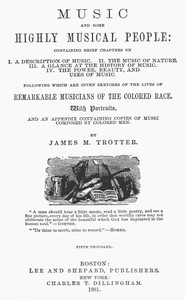
James M. Trotter's Music and Some Highly Musical People (1878) opens with a formal, encyclopedic table of contents that promises chapters on the nature and history of music before proceeding to biographical sketches of African American musicians. The book's structure itself enacts a claim: that these lives belong within a serious musical discourse. Trotter's prose, however, is far from uniform. In the sketch of Frederick Elliot Lewis, the narrator shifts from measured exposition to a tone of almost astonished admiration, describing a musician who performs on at least fifteen instruments with 'ease and pleasing finish.' This variation in register—from the didactic to the personal—is one of the work's most distinctive features.
A Voice That Alternates Between Authority and Wonder
Trotter's narrative voice is not static. In the opening chapters, he adopts the stance of a music historian, using broad, declarative sentences to define music's power and beauty. But when he turns to individual musicians, the tone becomes more intimate and evaluative. Consider the sketch of Frederick Elliot Lewis: Trotter begins by confessing that he does not know of any artist who equals Lewis in versatility, then immediately qualifies this with 'be this as it may.' The prose moves from a general claim to a specific, almost breathless enumeration of instruments—'piano-forte and the organ, on the violin, viola, violoncello, double-bass, and the guitar, on the clarinet and flute, on the cornet.' This list is not merely informative; it performs the very abundance it describes. Trotter also distinguishes Lewis from a 'prodigy' or 'supernatural being,' insisting instead on his intelligent method and long study. The voice here is that of a defender, carefully positioning his subject within a framework of cultivated artistry rather than mere novelty.
Pacing Through Accumulation and Anecdote
The pace of Trotter's prose varies markedly between sections. The biographical sketches often employ a cumulative rhythm, piling up details of accomplishment. In the Lewis sketch, the sentence 'He is acquainted, therefore, not only with the musical capacity of all the instruments he plays, but also knows so much in regard to their mechanism, that, when out of order, he can generally repair them' builds through a series of clauses, each adding a new layer of competence. This accumulation creates a sense of inexhaustible skill. By contrast, the passage on the Hyers sisters moves more quickly, with shorter sentences and a forward-looking tone: 'Mr. Hyers still holds to a resolve to take his talented daughters to Europe.' The pace here is aspirational, driving toward a future of operatic success. Trotter also varies pacing through direct address and rhetorical questions, as when he writes of Lewis, 'Indeed, you can scarcely bring to this remarkable musician an instrument upon which in tasteful and artistic manner he cannot perform.' The 'you' momentarily draws the reader into the scene, quickening the narrative tempo.
Recurring Details: Instruments, Repairs, and the Ideal of Cultivation
Certain details recur across the excerpts, forming a pattern that reveals Trotter's priorities. Instruments are not merely played but understood: Lewis learns 'all about its structure, the theory concerning its qualities, its tone-producing capabilities' before practicing. This emphasis on mechanical knowledge extends to repair—Lewis can fix his own instruments, and he keeps a 'large family of stringed instruments' chosen for 'beauty of form, and nicety and sweetness of tone.' The language of connoisseurship ('a decidedly good judge, a real connoisseur') reappears, suggesting that Trotter values not just performance but a holistic mastery. Another recurring motif is the distinction between natural gift and cultivated skill. Trotter explicitly rejects the label 'prodigy' for Lewis, instead attributing his success to 'assiduous cultivation' and 'severe, steady, and long-continued study.' This insistence on effort over innate talent is a thread that runs through the biographical sketches, positioning the subjects as artists who have earned their place through discipline.
Trotter's book rewards attention to its shifts in register—from the impersonal authority of the opening chapters to the invested, sometimes defensive voice of the biographies. Readers may find it useful to compare the treatment of different musicians, noting how Trotter adjusts his language to suit each subject. The recurring emphasis on mechanical knowledge and self-cultivation offers a lens through which to view the entire project: a work that argues for the dignity of its subjects by insisting on their artistry, their effort, and their place within a broader musical tradition.
Trotter’s portraits of the Hyers sisters made me feel the sheer longing behind their operatic ambitions, a quiet ache for stages that seemed just out of reach. That same ache resounds in Wagner's "Tristan und Isolde": An Essay on the Wagnerian Drama — Reading Notes, where yearning itself becomes the whole story. I keep thinking about how both works hear that same note—and hold it, unhurried.