About 298 minutes
Negro workaday songs — Edition Insights
Music History
68,486 recorded words. 8 minutes difference from this book's estimate.
View Gutenberg source #69378
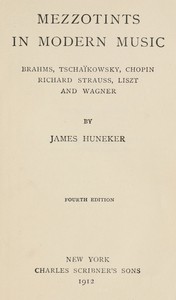
The catalog record for Mezzotints in modern music — A Closer Reading provides practical reading context through 66,607 words, 4 hr 50 min estimated reading time, and 14 detected text sections.
The text analysis averages about 16.3 words per sentence, while the detected sections provide another way to judge how the source is divided.
Project Gutenberg metadata also associates the work with “Liszt, Franz, 1811-1886,” connecting these edition facts with the source record’s subject description.
Explore this collection
These alternatives are selected using recorded categories and estimated reading time.
About 298 minutes
Music History
68,486 recorded words. 8 minutes difference from this book's estimate.
View Gutenberg source #69378About 279 minutes
Music History
64,128 recorded words. 11 minutes difference from this book's estimate.
View Gutenberg source #18560About 310 minutes
Music History
71,160 recorded words. 20 minutes difference from this book's estimate.
View Gutenberg source #29634Search stored excerpts and compare books → Choose by your preferences →
Choices use stored catalog measurements. Estimates vary with reading speed. A shared category is a catalog label, not a claim that two books have the same argument or literary quality.
Search reads excerpt text stored with this catalog and links to its associated Gutenberg record. The connection is stored in the site database; this tool does not recheck that every excerpt is word-for-word identical to that external record. Excerpt search does not cover every chapter and does not verify historical publication dates.
Catalog snapshot checked: 2026-09-25. Coverage: 90 public books, 90 available source excerpts.
Read the complete public-domain text at its original source.
Read on Project GutenbergJames Huneker opens his essay on Brahms by declaring the composer's death in 1897 removed 'the last of the immortals' from music, ranking him with Bach and Beethoven. He immediately confronts a common criticism: that Brahms held himself aloof from humanity. Huneker counters that the composer's 'marvellous spiritual obstinacy' and 'logical, consistent and philosophic bent' demand homage, not dismissal. The prose is combative and assured, setting a tone that persists throughout the collection.
Huneker frames Brahms's career as a half-century pursuit of 'the beautiful in its most elusive and difficult form' while 'the fashions of the hour, day and year mocked at such wholesale, undeviating devotion.' He lists Brahms's output—four symphonies, two piano concertos, a violin concerto, the German Requiem—not as mere enumeration but as evidence of 'high excellence.' The essay insists that Brahms's refusal to challenge current artistic tendencies was not remoteness but fidelity. Huneker's language is emphatic: he calls Brahms 'great, virile' and dismisses Dvořák, Verdi, and Saint-Saëns as incomparable. This opening establishes a pattern of strong advocacy and direct address to the reader.
In the chapter on Chopin, Huneker pivots sharply from the composer's popular image. He argues that the 'new, the larger Chopin will be known to posterity by the three great polonaises'—in F sharp minor, A flat, and the fantaisie polonaise (opus 61). His analysis of the F sharp minor polonaise is detailed: he notes the 'triplets in eighth notes in the introduction,' the 'second subject in D flat,' and the 'strange intermezzo in A' that precedes the mazurka. He calls the piece 'pathologic' but 'magnificent,' and insists it 'needs men, not pianists, to play it.' Huneker's technical observations—such as the advice to play thirty-second notes in octaves for more color—ground his polemic in musical specifics.
Huneker's disdain for the sentimental reception of Chopin erupts in a striking passage: 'If women must play the piano let them stick to Bach and Beethoven. They cannot hurt those gentlemen.' He calls the nocturnes 'sometimes beneath contempt' and laments that Chopin has been 'decked ... in petticoats.' Yet he makes exceptions, praising the C sharp minor nocturne as 'the gloomiest and grandest of Chopin's moody canvases' with a middle section 'Beethovian in breadth.' This section reveals Huneker's method: he uses strong, even hyperbolic language to provoke, but backs it with specific musical judgments. The reader is left to weigh his fervor against the evidence he provides.
Throughout the excerpts, Huneker adopts a persona of the discerning critic battling popular misconceptions. He invokes figures like Bülow, Schumann, Niecks, and Przybyszewski to bolster his arguments. Yet the excerpts are incomplete; we see only the opening of the Brahms essay and a portion of the Chopin chapter. The collection also covers Tchaikovsky, Richard Strauss, Liszt, and Wagner, but these sections are not represented here. Huneker's references to Nietzsche and to Przybyszewski's The Psychology of the Individual suggest a broader intellectual context, but the reader must consult the full text to see how these threads develop. The existing passages show a critic who is opinionated, technically informed, and unafraid of controversy.
Huneker's Mezzotints in Modern Music rewards readers who enjoy strong critical opinions grounded in musical detail. The essays are not neutral surveys but arguments, often provocative. Readers should approach them as period documents that reveal late-nineteenth-century debates about modernism, masculinity in music, and the role of the critic. The incomplete excerpts hint at a wider range of composers and ideas; the full text will likely deepen or complicate the positions staked out here.
I keep thinking of my father’s old record cabinet, the way he’d hum Brahms while dusting. This book’s defense of that music—its quiet stubbornness—reminded me of how I once felt reading Modern Musical Drift — Story, Setting & Ideas, that same sense of a friend arguing gently for a composer’s soul. Both feel like conversations, not lectures.
Build a private reading journal entry for this title.